
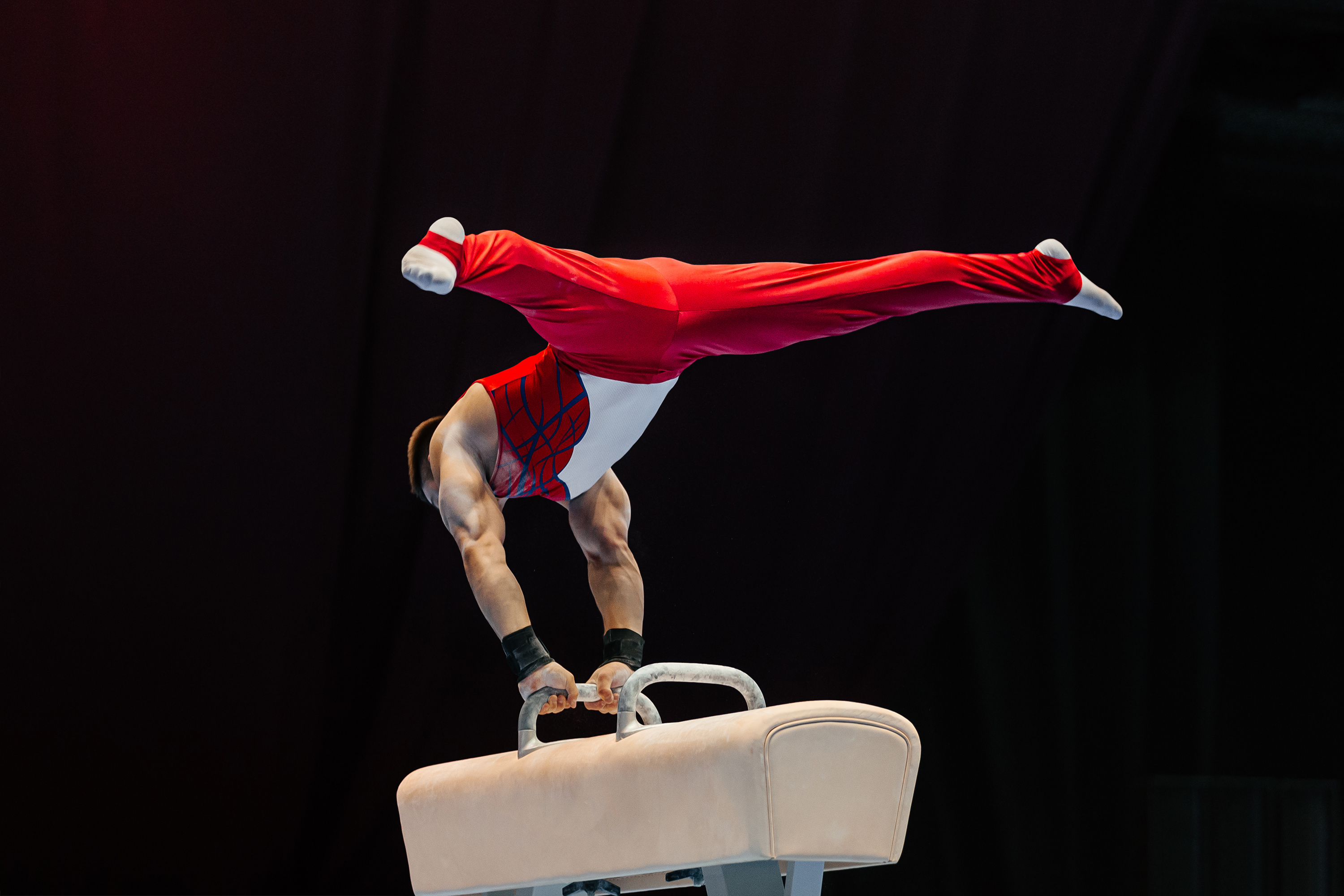
Pommel Horse in Men’s Artistic Gymnastics
Pommel Horse: Main Information
Pommel Horse received considerable media attention at the 2024 Olympics in Paris due to Stephen Nedoroscick‘s performances in the Qualifications, Team Final, and Event Final; he has been referred to as “Pommel Horse Guy,” “The Specialist,” or “Superman.” The act of removing his eyeglasses prior to his pommel horse routines has frequently drawn parallels to Clark Kent’s transformation into the superhero. In previous major competitions, the apparatus was never really in the spotlight.

The pommel horse serves as a critical gymnastic apparatus in men’s artistic gymnastics. Characterized by its horizontal, padded structure and two pommels (handles) situated atop, it requires gymnasts to execute a sequence of acrobatic movements and routines. These performances demand a high degree of balance and control, with particular emphasis placed on strength, form, and precision.

adjustable by +/- 1 cm (0.4 in)
The apparatus can be viewed differently by gymnasts depending on their strengths and preferences. For some, it is a favorite apparatus because it allows for the display of fluidity, strength, and artistry, and they may excel in performing its complex skills.
However, for others, it can be considered a “bogeyman” due to its challenging nature. The pommel horse requires a high level of upper body strength, balance, and coordination, making it difficult to master. Many gymnasts may struggle with the technical aspects of the routine, leading to a lack of confidence on this apparatus.
Ultimately, whether it is a favorite or a challenge varies from gymnast to gymnast.
Pommel Horse: the 2nd apparatus in the MAG Olympic order

Timeline of the Apparatus


8 things to know about Pommel Horse

IIIII Focus on other apparatus: Floor Exercise in Men’s Artistic Gymnastics
Scoring Pommel Horse

Judges receive comprehensive training to assess gymnastics routines by discerning the skills executed by the gymnast. They evaluate their performance based on a 140-page rule-book referred to as the Men’s Artistic Gymnastics Code of Points.
A gymnast’s final score comprises two principal components:
1. Difficulty score (D score)
2. Execution score (E score)
The D score reflects the complexity of the routine, whereas the E score assesses the quality of its execution. In determining the D scores for the floor exercise, the intricacy of the skills encompassed within the routine is duly considered.
The Difficulty Score
There are three components to calculate the Difficulty Score:
1. Difficulty Value
2. Composition Requirements
Difficulty Value
The ratings assigned to the eight most challenging skills within the routine are compiled to establish the Difficulty Value. The inclusion of hard skills plays a significant role in elevating the overall point total. Each skill is assigned a letter from A to J, with skills rated A being classified as the least difficult and receiving a value of 0.1. Following this, each subsequent letter denotes an incremental increase of 0.1 in value, reaching a maximum of 1 point for skill J. In Pommel Horse, the highest rated element is an F (but combined elements on a single pommel can create G or H).
Combined elements: on Pommel Horse, is possible to combine certain elements on a single pommel, which allows the gymnast to “boost” the value of the elements he performs. The process is not very easy to understand and it deserves a dedicated article.
Composition Requirements
Elements are categorized in 4 groups: they are ‘families’ of skills that are performed in a similar fashion :
1. ELEMENT GROUP I:
Single leg swings and scissors
2. ELEMENT GROUP II:
Circle and flairs, with and/or without spindles and handstands, Kehrswings, Russian wendeswings, flops and combined elements
3. ELEMENT GROUP III:
Travel type elements, including Tong Fei, Wu Guonian, Roth and Traveling Spindles
4. ELEMENT GROUP IV:
Dismounts
These requirements represent essential skill types that ensure gymnasts demonstrate a comprehensive array of elements in their routines. The difficulty of the elements may vary, ranging from fundamental skills to challenging maneuvers, provided they conform to the specified type.
The Execution Score
The E score represents the deduction of points in gymnastics evaluation. The base score is 10.0 for all routines, reflecting the legacy of the well-known “Perfect 10.” The judging panel for the E score applies deductions for errors in form, execution, technique, and routine composition. Errors are categorized as small, medium, or large, leading to deductions of 0.1, 0.3, and 0.5 points, respectively.
A significant penalty of 1.0 point is imposed for falls. Points are deducted for each execution fault in the routine, as outlined in the Code of Points. Consequently, the final E score is calculated as 10, subtracting all accumulated deductions.
Penalty, aka Neutral Deductions
There is one more component of gymnastic scoring, i.e. penalties, also called neutral deductions. They are very rare on Pommel Horse, as opposed to Floor or Vault, and would concern mostly time or attire issues, behavior or apparatus violations, or not having enough skills in a routine.
What’s a “good score” on Pommel Horse?
Based on the latest major international competitions of the 2022-2024 Olympic Cycle, we can identify some indicators that can help understand the rankings.
The table below shows the average and highest execution, difficulty and total scores. The highest total score of the quad was 15.533 by Rhys McClenaghan, who won gold at the 2024 Olympics*. The data shows what the best PH specialists could reach in the event finals.
* this score was overcome only a few times in other competitions like continental championships or World Cups
Average and Highest Scores in the 2022-2024 Olympic Cycle
| Highest Difficulty Score | 6.9 (Max Whitlock – 2024 Olympics – Event Final) |
| Average Difficulty Score | 6.4 |
| Highest Execution Score | 8.930 (Rhys McClenaghan – 2024 Olympics – Event Final) |
| Average Execution Score | 8.070 |
| Highest Total Score | 15.533 (Rhys McClenaghan – 2024 Olympics – Event Final) |
However, the average scores recorded in the Qualifications at the 2023 World Championships, where 220 gymnasts from 60 countries participated, exhibited significant variation. The broader spectrum of elite gymnasts presents a distinct perspective on what constitutes a “good score.” In the All-Around competition, which requires gymnasts to demonstrate proficient mastery across all six events, the scores were notably higher.
Average and Highest Scores at the 2023 World Championships
| Average D score – Qualifications | 5.3 |
| Average E score – Qualifications | 7.858 |
| Average Total Score – Qualifications | 13.200 |
| Average D Score – All-Around | 5.6 |
| Average E Score – All-Around | 8.030 |
| Average Total Score – All-Around | 13.634 |
It is important to note that, in 2025, the aforementioned average data is expected to undergo modifications as a result of the implementation of the 2025-2028 Code of Points, which alters the criteria by which routines are evaluated. This is also why it’s difficult to compare routines over the years: gymnasts and their coaches adapt the construction of their routines to maximize the difficulty in accordance with the Code of Points.
Scared of Pommel Horse?
WHY DO SOME GYMNASTS FREAK OUT ABOUT THE POMMEL HORSE?
1. COMPLEXITY OF MOVEMENT
It requires a high level of precision and technique. Gymnasts must execute continuous circular motions (called flairs or circles) while maintaining balance and control, which is very difficult. Even small errors in hand placement or body position can lead to deductions or falls.
2. REPETITIVE STRAIN
The constant swinging and support on the arms place significant strain on the wrists, shoulders, and elbows, leading to discomfort or even injuries. The apparatus demands solid abs, a great deal of upper body strength, and endurance, which can be grueling over time.
3. UNFORGIVING NATURE
The pommel horse is often referred to as “unforgiving” because a single misstep can ruin an entire routine. Unlike some other apparatuses where recovery might be possible, a fall or break in rhythm on the pommel horse is typically catastrophic.
4. MENTAL CHALLENGE
It’s a mentally taxing apparatus because gymnasts must maintain intense focus and rhythm throughout the routine. The fear of falling or failing to complete a sequence adds psychological pressure.
This is also why Stephen Nedoroscik, who is a PH specialist, and who was selected in the US Olympic Team for his very high score on this event, had such a weight on his shoulders; Additionally, as the American team commenced their competition on the rings, Stephen had to wait for the entirety of the competition before executing his routine. During this time, he watched and supported his four teammates performing on the other five apparatuses, while he engaged in mental preparation for what would be the most pivotal 40 seconds of his career.
No other nation selected a gymnast for only one apparatus; all other specialists in each of the other 11 teams participated in at least two events. The American strategy, based on a very detailed mathematical process, proved to be effective and contributed to the team securing a bronze medal (and an individual one to Stephen).
5. LIMITED SPECTATOR APPEAL?
Many feel the pommel horse lacks the “wow factor” that other apparatuses offer. This can make it less rewarding to perform, as it doesn’t elicit as much excitement from audiences…. although the 2024 Olympics may change this bias: the popularity of Stephen Nedoroscik and Olympic Champion Rhys McClenaghan can definitely change the perception of PH. Both gymnasts were invited to take part to Dancing With The Stars (US and Ireland’s versions), proving that their athleticism can be used for other things.
The G.O.A.T.S of Pommel Horse at the Olympics

The G.O.A.T.S of Pommel Horse at World Championships

2006: THE NEW CODE OF POINTS
In 2006, a comprehensive revision of the Code of Points was launched and an entirely new gymnastics scoring system was implemented. This change was necessitated by the judging controversies that arose during the 2004 Olympic Games, particularly regarding a judging error related to South Korean gymnast Yang Tae Young‘s Parallel Bars performance in the All-Around, as well as the discontent expressed by the audience concerning the score awarded to Russian gymnast Alexei Nemov in the Horizontal Bar final, which was perceived as too low.
Such events called into question the reliability and objectivity of the scoring system, and ignited debates regarding the potential prioritization of execution over difficulty in artistic gymnastics. This marked the conclusion of the “Perfect 10” era in the FIG’s (Fédération Internationale de Gymnastique) competitions.
Want to know more?
The MAG Code of Points 2025-2028: Review & Analysis
FIG: PH Features & Characteristics


Leave a Reply