
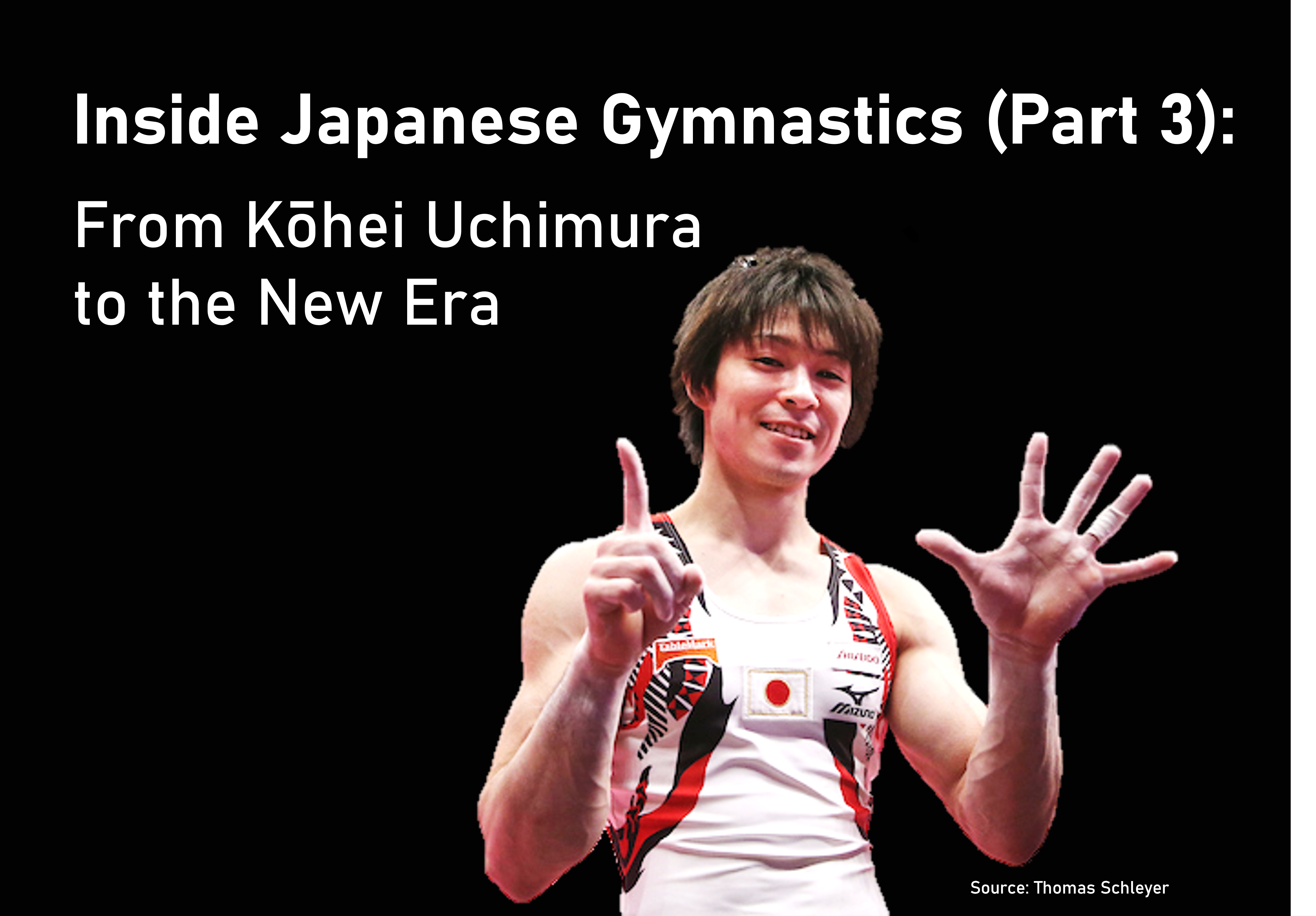
Inside Japanese Gymnastics (3): From Kōhei Uchimura to the New Era
In Parts 1 and 2, we explored the institutional system of Japanese gymnastics – the university system and the “Beautiful Gymnastics” philosophy, as well as their training protocols and FX an HB unique techniques. In Part 3, we conclude our deep dive by looking at the legends who have defined this system, from Kōhei Uchimura to Daiki Hashimoto, and by examining the unvarnished coaching insights from Dr. Sho Itoh.
1. The Legends: Their Specific “Secret” Training
The Japanese system is not just a set of rules; it is a lineage of champions who have each added their own “secret” to the collective knowledge.
1.1 The God: Kōhei Uchimura (“King Kōhei”)
Uchimura didn’t just “feel” where he was; he visualized it like a schematic.
The Notebook: He kept detailed sketchbooks where he drew his skills frame-by-frame, including the vector of the force he felt.
The “Stop the Air” Landing: Unlike many who just “stop the landing”. Kōhei Uchimura visualizes his landings as “stopping everything, even the air around me”
The Drill: Trampoline “Dead Stops.” He would perform a complex saltos on a trampoline and land completely still (no bounce). This requires firing the core and quads at the exact moment of impact to negate the rebound energy.
1.2 The Twister: Kenzō Shirai (“The Corkscrew”)
Kenzo could perform four twists (the Quad) not because he was stronger, but because his axis was narrower.
The “Mummy” Drill: To train tight twisting, he practiced wrapping his arms so tight his elbows touched his belly button.
Tumble Track Volume: Kenzō would spend two hours a day just on the tumble track, doing 3.5 twists, then 4 twists, playing with the “limit.” He treated twisting like a video game, not a workout.
1.3 The Grinder: Kazuma Kaya
Kaya is known as the “hardest worker.” His moniker is “Kappo” (Stroll/Strut) because he never shows weakness.
The 100-Circle Standard: He wouldn’t leave the mushroom until he did 100 double-leg circles in a row. If he fell at 99, he restarted. This builds the specific endurance in the traps and lats that allows him to execute difficulty at the end of a routine when others are fatiguing.
1.4 The New Era: Daiki Hashimoto
Hashimoto represents the “Endless Engine” of Juntendo University.
Lactate Threshold Training: They perform routines with less rest than competition standards. In practice, they might do a floor routine, rest 30 seconds, and go again. By the time they get to a meet (where they wait 10 minutes between turns), the routine feels effortless.
2. The “Dr Sho Itoh” Notes: Unvarnished Coaching Insights
Dr. Sho Itoh, a gymnast for 17 years and part of the Kōhei Uchimura generation, provides a unique perspective on the system’s inner workings.
2.1 The “Long Game” for Juniors
Basics Until 15: Until U15, the focus is entirely on body position, flexibility, and basics. It is extremely detailed. They try to improve “muscle feeling” and “feel” the skill. During this time, athletes are completely reliant on their coach in order to absorb as much knowledge as possible.
Puberty Scaling: During puberty, training is scaled back to prevent pain and allow the body to recover. Takeru Kitazono, for example, scaled back training heavily before Tokyo to ensure he was ready for full-scale training at 16.
2.2 The “1.5 Hour” Conditioning
In Osaka, juniors might perform 1.5 hours of conditioning every day. This includes:
Scapular Isolation: Bear walks where you “feel” with the scapula.
Basic Proprioception: Simple arm and hand movements to build a deep connection with the body.
2.3 High Bar: The “Strap Bar” Foundation
Before learning a Tkatchev, a Japanese gymnast must master:
Adler, El-Grip, Double Layout, Stalder, Endo, and Turns.
Stoop Handstand THEN Stoop Half: Coaches try to predict 8-12 years into the future, focusing on B and C skills so gymnasts can adapt later.
2.4 The “Stick” Philosophy
Simple Landing Drills: Good body position is paramount.
Strict Deductions: Even for juniors, small hip deviations on landings are strictly penalized.
The “Step Back” Rule: A step back is considered better than a step forward (which often indicates the chest is too low).
3. Summary: The Culture of “Shuhari”
Every Japanese gymnast follows the concept of Shu-Ha-Ri:
Shu (Obey): In junior high, you copy the master exactly. Perfect form. No deviation.
Ha (Digress): In university, you learn the science. You understand why the form works. You start to experiment.
Ri (Separate): As a pro, you create your own style. You transcend the rules.
4. Recap

Kōhei Uchimura:
Perfect visual spotting + absolute stoppage of rotation.
(c) Getty

Daiki Hashimoto:
Infinite endurance + scientific efficiency (Juntendo method).
(c) Eric T’Kindt

Kenzō Shirai:
Narrow axis twisting + high volume tumble track.
(c) Angelos Zymaras / Penta Press

Kaya Kazuma:
Mental fortitude + high rep conditioning.
(c) Laurence Griffiths / Getty

Yūsuke Tanaka:
Most perfect basics in Japan, often shown to juniors as an example.
(c) Laurence Griffiths / Getty
The Japanese system is not magic; it is Physics + Patience. They don’t train to be “strong”; they train to be “efficient.” They view the body as something completely under their control and a fine tool to do beautiful gymnastics.
Doctor Sho Itoh
Dr Sho Itoh has a PhD in Sport Psychology at Victoria University, Australia and a MEd in Education at Nihon University in Tokyo. He was part of The Tokyo Organising Committee of the 2020 Olympic and Paralympic Games and has been operating as Technical Operation Manager in all Gymnastics disciplines for the 2026 Aichi-Nagoya Asian Games and Asian Para Games Organizing Committee.
He provided us with exclusive information about the training system in Japan and his experience as a gymnast in the 1990s and 2000s.
Dr Sho Itoh’s LinkedIn Profile
5. Kōhei Uchimura: The Whole Story
Kōhei Uchimura, often hailed as “King Kōhei” and widely regarded as one of the greatest artistic gymnasts of all time, is a Japanese phenomenon celebrated for his unparalleled dominance and a unique blend of difficulty, consistency, and elegance in his performances. Born on January 3, 1989, in Kitakyūshū, his journey in gymnastics began at the age of 3, nurtured by his parents, both former competitive gymnasts who ran a local club.
5.1 Early Life and Career Foundations
Kōhei’s early immersion in gymnastics provided him with a profound head start, enabling him to master fundamental techniques and develop crucial neural pathways and muscle memory for advanced skills. At 15, he relocated to Tokyo to train under Athens gold medalist Naoya Tsukahara, further honing his abilities. He joined Japan’s national team in 2007, making his senior debut at the Paris World Cup, where he secured a bronze medal on vault.

5.2 Records and Medal Counts
Uchimura’s career is decorated with an extraordinary collection of medals and groundbreaking records, primarily in the all-around competition.
Olympic Games:
– Seven-time Olympic medalist, comprising three gold and four silver
– Became the first male gymnast in 44 years to win back-to-back individual all-around gold medals at the Olympic Games (London 2012 and Rio 2016)
– Contributed to Japan’s team silver in Beijing 2008 and London 2012, and team gold in Rio 2016.
– His Olympic all-around silver in 2008 marked Japan’s first Olympic medal in the event in 24 years.
World Championships:
– Twenty-one-time World medalist (including team, all-around, floor exercise, parallel bars, and horizontal bar).
– Achieved an unprecedented six consecutive all-around gold medals at the World Championships (2009–2015), a feat unmatched by any other gymnast, male or female.
– His collection includes 10 World Championships gold medals.
5.2 Training Philosophy and Techniques
Kōhei Uchimura’s success was rooted in his profound dedication and a distinct approach to training:
Relentless Practice and Consistency: Kōhei’s personal philosophy is, “I don’t believe in God. I never had lucky charms. All I believe in is practice”. He had stated, “I cannot live a day without practicing. I feel uncomfortable if I don’t practice.”.
Difficulty and Execution: He is renowned for delivering difficult and accurately executed routines, a “combination of tremendous difficulty, supreme consistency and extraordinary elegance of performance”. His goal was “beauty in movement”.
Strategic Training Bursts: Rather than prolonged training, Uchimura favored “short bursts of high-quality training”. This intensified his practice sessions, especially leading up to major competitions, where he focused on perfecting full routines.
Technical Focus: Kōhei Uchimura and his coaches emphasized the technical aspects of gymnastics. He reportedly used video analysis after each turn to review his skills and identified areas for improvement.
Muscle Stimulation and Flexibility: His morning routines were dedicated to muscle stimulation, flexibility, and strength work, crucial for world-class performance.
Recovery and Motivation: His coach, Hiro Sato, highlights the importance of recovery weeks in his training regimen, especially given the demanding nature of gymnastics and Kōhei Uchimura’s career longevity. Maintaining motivation, particularly during injury recovery, is also a key aspect addressed by his coaching staff, often through engaging in new skills to keep training interesting.
Comprehensive Apparatus Mastery: Uchimura excelled across all six men’s artistic gymnastics apparatuses, showcasing remarkable versatility and contributing to his all-around dominance. He understood that each apparatus demands different physical attributes and techniques; for example, vault requires leg strength, rings demand arm strength, while pommel horse relies on centrifugal force control.

5.3 Diet & Lifestyle
Kōhei Uchimura’s dietary habits have garnered significant attention due to their unconventional nature for an elite athlete:
One Meal A Day: Uchimura famously adheres to a regimen of eating only one main meal per day, typically in the evening after his two daily workouts.
Rationale for Empty Stomach: His primary reason for this unusual diet was to avoid feeling sick while performing complex spins and movements during training and competition. He feels it was easier to move and perform optimally on an empty stomach.
Limited Vegetable Intake: He has openly admitted to disliking vegetables, particularly green ones and tomatoes.
Caffeine for Fuel: Prior to his evening meal, he typically fuels himself with coffee and avoids snacking throughout the daylinklink.
Evening Meal Composition: While his daily intake is limited to one meal, it is reported to consist of a high-calorie intake, typically including raw fish, lean meats, and fiber-heavy vegetables (despite his general aversion). Hydration is also cited as a crucial element of his routine.
Note: Since 2019, the Japanese government has updated the rules for writing Japanese names in Latin characters to place the surname first, followed by the given name. This order is used in international sports competitions to reflect Japanese culture, and the International Olympic Committee applied these guidelines during the Tokyo 2020 Olympics and in later events.
While recognizing the updated guidelines from the Japanese government and the International Olympic Committee to present Japanese names in the order of Surname followed by Given Name, Zhoxxyy has opted to refer to the athlete as Kōhei Uchimura. This decision is made as an exception to our usual practice of adhering to the Surname + Given Name format. This choice reflects his widespread recognition in international media and on his personal social media channels, where he consistently uses the “Kōhei Uchimura” (First name + Surname) convention.




Leave a Reply