
Chinese Men’s Gymnastics: A Cultural Evolution
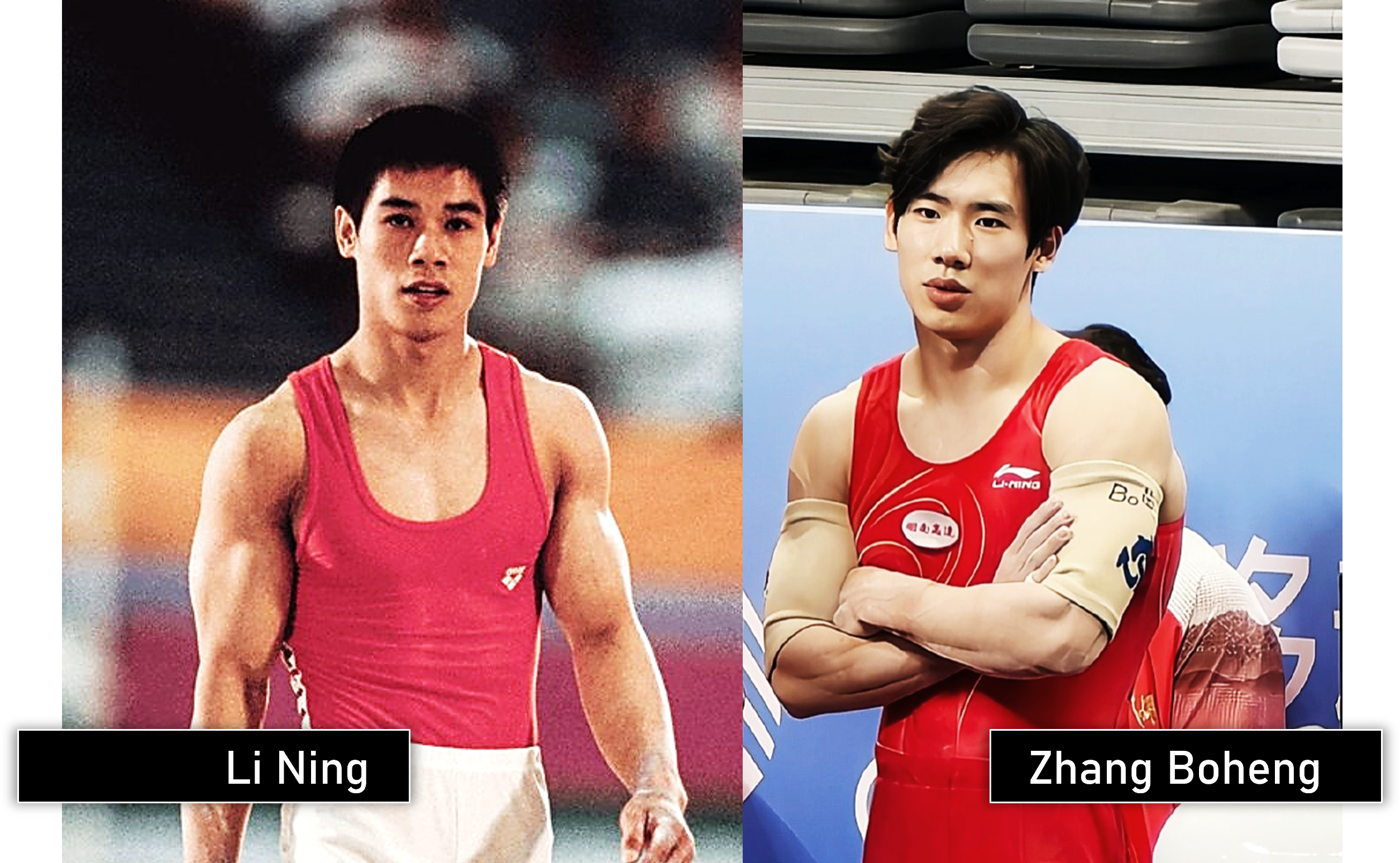
In the world of elite gymnastics, the Chinese team has long been a symbol of technical perfection and unwavering discipline. But if you look past the pointed toes and the stuck landings, you’ll find that the men under the red flag today are fundamentally different humans than the legends who preceded them.
The shift from the “Iron Generation” of the 1980s and 90s to the “Expressive Generation” of the 2020s isn’t just about better equipment. It is a profound psychological transformation, a move from gymnastics as a military duty to gymnastics as a personal, albeit national, journey.
The Weight of the State: The Era of Shame and “Dead Resistance”
For the old guard, men like 李宁 (Li Ning), 李小双 (Li Xiaoshuang), and 黄力平 (Huang Liping), gymnastics was never about “loving the sport.” It was a mission. Under the 举国体制 (Whole Nation System), these athletes were raised as near “soldiers”. The training method was famously unscientific, favoring 大量 (Large Volume), the idea that if you simply did more repetitions than your body could handle, you would break through and win.
Instant Noodle Mourning
One of the most harrowing accounts of this mindset occurred during the 1996 Atlanta Olympics Team Final. After his hand slipped on the rings in a freak accident, multiple falls on the horizontal bar, team China lost the gold to Russia, Li Xiaoshuang, the fierce leader of the team, was so overcome with humiliation that he reportedly smashed his silver medal in the locker room, leaving a visible dent in the medal. To him, silver was not a victory; it was a badge of failure.
The aftermath was even more telling of the era’s “shame culture.” Li Xiaoshuang and teammate Huang Liping were so broken by the loss that they refused to enter the dining hall for two days. They stayed in their rooms, out of sight, surviving solely on instant noodles because they felt they did not “deserve” to eat with the winners. They emerged only for the All-Around final, driven by a desperate, almost painful need to redeem their honor.
The Price of a Smile
We see this cultural rigidity most clearly in the tragedy of Li Ning in 1988. When the “Prince of Gymnastics” fell in Seoul, he stood up and offered a faint, sad smile. To a modern audience, it was a display of grace; to the Chinese public of 1988, it was a betrayal. He was accused of “laughing off” a national tragedy. The backlash was so severe he received death threats and razor blades in the mail. In that era, the athlete’s body belonged to the state, and their emotions were strictly regulated: stoic in victory, devastated in defeat.
Training Philosophy: Volume vs. Science
The old generation trained until their bodies literally broke. Li Xiaoshuang famously competed while managing a concussion and reportedly took upwards of 40 painkillers to survive a single competition. There was no “smart training”, only “large volume.”
Contrast this with the modern era. Today’s training center in Beijing utilizes video gait analysis, sports psychologists, and data-driven recovery protocols. The philosophy has shifted from “breaking the body” to 快乐体操 (Happy Gymnastics) at the foundational levels and “Optimized Training” for elites. This scientific approach has allowed for a more “human” athlete to emerge – one who has the mental bandwidth to be more than just a scoring tool.
The Expressive Generation: Hype, Humor, and Humanity
The modern Chinese gymnast is a different breed. They are influencers, jokers, and open books.
The Social Media Pioneer
The turning point arguably began with 冯喆 (Feng Zhe) during the 2012 London Olympics. Known as “Feng Fatty,” he used social media to crack jokes about his coaches and his own nerves. He broke the “military” mold, showing the world that a Chinese gold medalist could be funny and relatable. He proved that you could win for your country without losing your personality.
The Captain’s Transparency
Today, we have 张博恒 (Zhang Boheng). Unlike the stoic captains of the past, Zhang Boheng is remarkably open. In interviews and on the reality show《我家那小子 (My Little One), he speaks candidly about his fears, including a childhood fear of heights, and the grueling physical pain of his injuries. He even shared a story of having his swollen gums cut with a knife to drain blood just to be able to compete.
When the Chinese Men’s Gymnastics team suffered a heartbreaking loss in Paris 2024 due to 苏炜德 (Su Weide)’s falls, the reaction was not one of “shame and instant noodles.” Instead, Zhang Boheng was seen publicly comforting Su Weide. The “hype” culture has arrived; modern gymnasts cheer, shout, and celebrate domestic hits with a level of emotion that would have been deemed “undisciplined” thirty years ago.


Source: Getty
The Verdict
The difference between the old and the new is the definition of “Responsibility.”
To the old generation, responsibility was a burden of shame, a debt to be paid to the state through medal count. To the modern generation, responsibility is a professional pursuit. They still want to win “for China,” but they are allowed to love the process, to smile after a fall, and to be human beings first.
As we look at the hype and celebrations of the current team, we aren’t seeing a lack of seriousness. We are seeing a more mature sports culture, one that finally realizes that a gold medal is worth more when the person wearing it isn’t broken inside.

Source: Zhang Boheng’s Instagram
More:
How China Wins: Chinese Still Rings Training Secrets Revealed
Asian Gymnastics Union
Chinese Men’s Gymnastics Chinese Men’s Gymnastics Chinese Men’s Gymnastics Chinese Men’s Gymnastics Chinese Men’s Gymnastics


Leave a Reply