
Chinese Gymnast Yang Wei: From Reject to Olympic Champion
As a sickly child deemed too weak and disproportionate for gymnastics, Yang Wei was never the biggest talent in the room. What he had instead was an unwavering self-belief and grit: blossoming into a gymnast with ridiculous difficulty on every single apparatus, at a time when most All-Arounders only excelled at a couple.
It took him from 1996 to 2008 to turn that completeness into the title that mattered most, and the story of those twelve years is one of the most brutal arcs in modern gymnastics.
More:
Chinese Men’s Gymnastics: A Cultural Evolution
How China Wins: Chinese Still Rings Training Secrets Revealed
- 1. The Reject Who Became the Ace
- 2. Sydney 2000: Gold with the Team, Silver by 0.113
- 3. Anaheim 2003: Beaten by Four Hundredths of a Point
- 4. Athens 2004: The Travesty
- 5. 2006–2007: The Threepeat No One Had Seen in 80 Years
- 6. Beijing 2008: The Ultimate Triumph
- 7. Retirement, the Whistle, and Reality TV
- 8. 2026: Where is he now?
- 9. Conclusion
- 10. Yang Wei's Medal Count

Source: Bob Thomas Sports Photography via Getty Images
1. The Reject Who Became the Ace
He was born on February 8, 1980, in Xiantao, a small city in Hubei Province already famous in the gymnastics community as the hometown of Olympic champion Li Xiaoshuang. You would expect Yang Wei to join the elite path from the very beginning, but this couldn’t be farther from the truth. As a small child, he was frequently ill and unhealthy. This concerning lack of vitality led his parents to enroll him in his city’s local gymnastics program.
When he was 10, scouts from the Hubei provincial team looking for suitable children to train gymnastics, spotted him: his physical build reportedly gave the selectors pause; he was frailer and skinnier than his already lean and small statured peers. They rejected him under the premise that he was too sickly and that his knees were too big for gymnastics.
But coach Ding Jie thought otherwise; he took Yang Wei under his tutelage within the Wuhan Sports University athlete system. Under coach Ding
Jie’s mentorship, he trained as a professional student-athlete. His training was absolutely grueling: from hour long handstands to endless drilling while battling injuries.
At 16, he got recruited into the national team in Beijing, under Huang Yubin’s coaching. The teenager endured even harsher and brutal training. His level of gymnastics skyrocketed, propelling him to domestic All-Around champion.
He announced himself internationally in 1998, taking team gold and floor gold at the Bangkok Asian Games, and again at the 1999 World Championships in Tianjin, where he won team gold and a bronze on horizontal bar in his first appearance on the sport’s biggest non-Olympic stage.
2. Sydney 2000: Gold with the Team, Silver by 0.113
At the 2000 Sydney Olympics, Yang Wei was part of the Chinese men’s team that won the country’s first-ever Olympic team gold in gymnastics, a genuine breakthrough for the program. Individually, he finished the All-Around final in second place, 0.113 points behind Russia’s Alexei Nemov. It was the first of what would become a nightmarish defining pattern in Yang Wei’s
career: getting agonizingly close to individual gold, and having to settle for something else.
3. Anaheim 2003: Beaten by Four Hundredths of a Point
By 2003, Yang Wei was the undisputed ace of Chinese gymnastics: the top All-Arounder in peak form. Yang was in his prime and ready to tackle any major championship that came his way. At the 2003 World Championships in Anaheim, Due to unsteady landings on high bar and floor, Yang Wei lost the All-Around title to the USA’s Paul Hamm by just 0.046 points, one of the
tightest finishes in the event’s history.
He again anchored China’s team to gold, but the individual title – the one measure of a gymnast’s completeness the sport takes most seriously – kept slipping past him by margins too small to really be called margins at all.
4. Athens 2004: The Travesty
If Sydney and Anaheim were heartbreaks, Athens was simply a tragic Games. A costly error on horizontal bar during the All-Around final dropped Yang Wei to 7th place individually, while the Chinese men’s team – the reigning Olympic and world champions on paper – finished off the podium entirely.
For a gymnast who had built his reputation on being the most complete athlete in the field, it was a rare and public reminder that completeness doesn’t guarantee a good day. After the individual All-Around, outside the Olympic village, Yang Wei knelt and apologized to his coach (Huang Yubin), telling him that he was sorry for letting him down, and sorry for losing
the gold, a rock bottom moment. Huang told him to stand up, and said “we still have another chance, we still have another Olympics”.
Afterwards, Yang Wei considered retiring completely, as he would be 28 by the time of the next Olympics and almost certainly riddled with injuries: battling thoughts with an unfinished career but grappling with the reality of another 4 years of sheer grind, he spoke with his coach.
After voicing his thoughts, Coach Huang gave him a revelation. “If you were in peak form both mentally and physically and lost, who’s to say that you won’t win if you’re in poor mental and physical shape?” That statement alone solved all of Yang Wei’s hesitation, and he decided to continue training with a renewed focus.
5. 2006–2007: The Threepeat No One Had Seen in 80 Years
Yang Wei rebuilt from Athens the same way most great Chinese gymnasts rebuild: quietly, and through volume. He declined all major championship opportunities in 2005 just to focus on consolidating his training. At the 2006 Doha Asian Games he swept four golds – team, All-around, rings, and parallel bars – a statement performance ahead of that year’s World Championships in Aarhus, Denmark, where he finally broke through: team gold, All-Around gold,
and parallel bars gold.
According to Baidu, this made him the second gymnast in the 104-year
history of the World Gymnastics Championships to successfully defend the men’s individual All-Around title, when he repeated as champion at the 2007 World Championships in Stuttgart (before Kōhei Uchimura’s era).
By 27, an age most All-Around gymnasts were already contemplating retirement, Yang Wei had become the man to beat in the one event that had spent seven years finding new ways to deny him.
6. Beijing 2008: The Ultimate Triumph
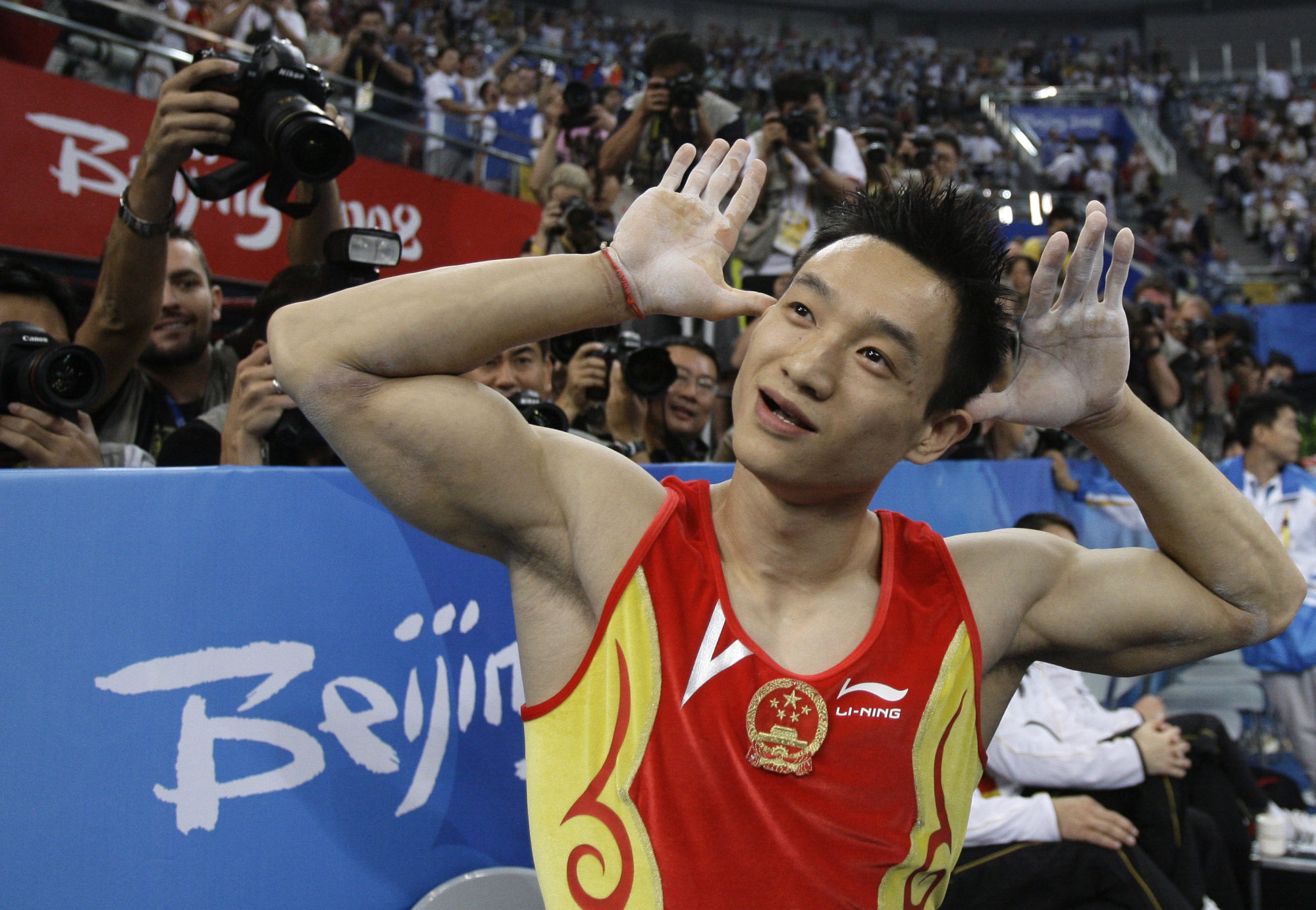
The home Olympics were, by every account, the moment everything Yang Wei had built finally paid off in full. He won the All-Around gold with a score of 94.575, a margin of roughly 2.6 points over the field, not a nail-biter this time, but a statement. He anchored China’s men to another team gold, and added an individual silver in rings (16.425), finishing behind teammate Chen Yibing, who delivered China’s first Olympic rings gold since 1984.

Source: Bob Thomas Sports via Getty Images
He rounded out the Games with a 4th-place finish on pommel horse. It closed the loop that Sydney and Anaheim had opened: the two silvers separated by fractions of a point were now bookended by an Olympic All-Around title won comfortably, on home soil, in front of a Beijing crowd that had waited twelve years to see a Chinese man win it.
His signature vaulting technique was influential enough in the sport that a vault variation now carries his name in the Code of Points.
7. Retirement, the Whistle, and Reality TV
Off the podium, Yang Wei became one of Chinese gymnastics’ most recognizable public figures. He married fellow Olympic gymnast Yang Yun, a bronze medalist on uneven bars at the same 2000 Sydney Games, on November 6, 2008. Their son, born in Hong Kong one year later, on
November 6, 2009 (the same calendar date as their wedding), and nicknamed “Yang Yangyang,”. The couple had twin daughters in January 2017.
Yang Wei’s retirement was approved in May 2009, at age 29. Rather than stepping away from the sport entirely, he pursued international judging certification and went on to officiate atmultiple competitions, before moving into administration: deputy director of the Hubei Provincial Gymnastics Management Center in 2011, and its director from 2014.
He stepped away from gymnastics management in 2015, citing that he wanted to try new careers and avenues. He became a public figure and participated in reality TV shows and movies. His son Yang Yang became a genuine child celebrity through the reality show Where Are We Going, Dad?, first as a cast member in the show’s 2014 season and then in its 2015 spin-off film

Source: Visual China Group via Getty Images
He also opened a children’s gymnastics club with fellow former gymnast Feng Lin in an attempt to introduce recreational gymnastics to Chinese parents, which later closed in 2021. Despite the prize money from his plethora of medals and successful acting career (relatively), he struggled to find a career outside of gymnastics that he truly fit into.
Then, in 2022, a friend asked him if he knew about Douyin (Chinese Tiktok) live streaming. Yang replied “What’s Douyin?” His friend explained that live streamers on the platform sold products to live audiences in order to make a
profit: Chinese shoppers preferred livestream shopping as opposed to website shopping due to the ability to have live interactions with the products and streamers.
Yang decided to start by watching other live streamers, he spent countless hours and days sitting through entire sessions and observing how their staff and the streamer worked. He learned to speak clearly and concisely by taking public speaking classes. The novice streamer hired a staff of editors, supply
controllers, script writers etc. and went straight to work. Using his Olympic and celebrity fame to establish his personal brand.
In October 2023, Yang Wei disclosed a serious, previously undiagnosed case of sleep apnea, revealing that he had experienced breathing interruptions of up to six minutes during sleep and now relies on a CPAP masker every night, a strikingly human detail from an athlete whose career was built on physical control.
8. 2026: Where is he now?
In addition to commentating on many elite level competitions such as the Paris Olympics, by 2026 Yang Wei is an internationally certified judge, successful businessman and livestreamer, and proud father of three children. He lives in Hubei, Wuhan and raises his two daughters along with his wife, Olympic Champion Yang Yun. His son Yang Yang attends school in Hong Kong
and Yang has his eyes set on returning to gymnastics domestically as a spokesperson, commentator, and active judge.
9. Conclusion
After overcoming his natural physical shortcomings through sheer effort and training, Yang Wei’s career resists the easy underdog narrative because he was, in almost every technical sense, the opposite of an underdog, a gymnast without a weak event, drilled from age five into one of the most complete All-Arounders of his generation.
What makes his story compelling instead is the amount of time it took the sport to reward that completeness: eight years and two heartbreak silvers separated by a combined 0.16 points, one lost Olympics in Athens, and finally, at an age when most of his peers were already retired, back-to-back world titles and an Olympic gold that nobody could argue with.
Nearly two decades after Beijing, he remains one of the most complete gymnasts the sport has produced
10. Yang Wei’s Medal Count
| Competition | Gold | Silver | Bronze |
| Olympic Games (2000, 2004, 2008) | 3 (2× Team, All-Around) | 2 (All-Around, Rings) | - |
| World Championships (1999–2007) | 7 (4× Team, 2× All- Around, Parallel Bars) | 1 (All-Around) | 2 (Horizontal Bar, Vault) |
| Asian Games (1998–2006) | 8 (3× Team, 2× All- Around, Floor, Rings, Parallel Bars) | 2 (All-Around, Vault) | 1 (Floor Exercise) |
Source:
Baidu Baike: 杨威
Olympedia: Yang Wei
Sohu (May 2026): Family Housing Situation in Hong Kong
Chinese gymnast Yang Wei Chinese gymnast Yang Wei Chinese gymnast Yang Wei Chinese gymnast Yang We Chinese gymnast Yang Wei Chinese gymnast Yang Wei Chinese gymnast Yang Wei Chinese gymnast Yang We


Leave a Reply