
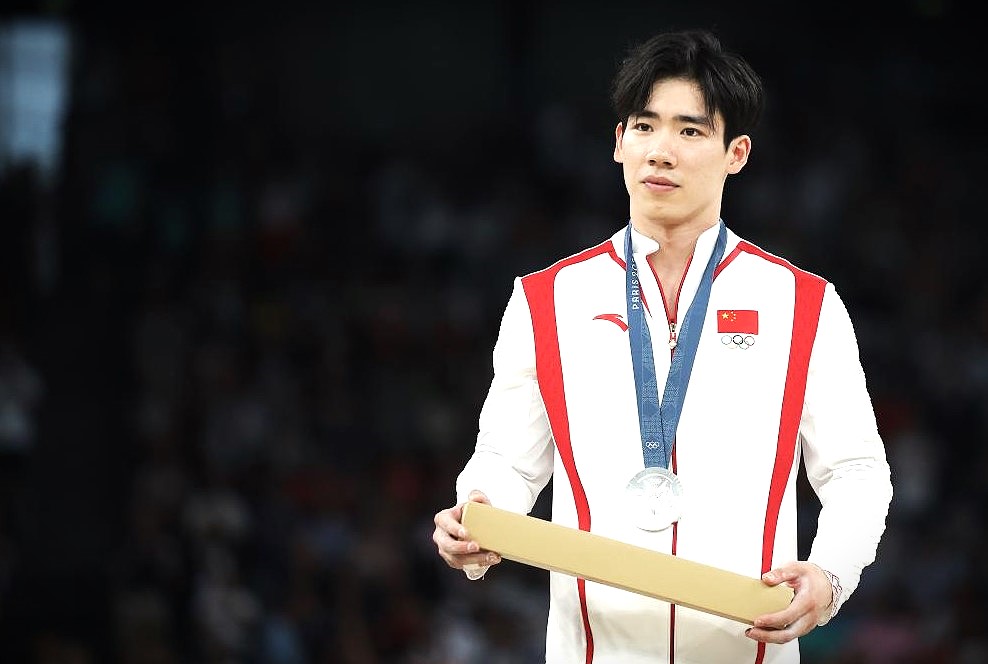
Zhang Boheng: Triumph Over Silver, All-Around Gymnastics Star
Zhang Boheng, born on March 4, 2000, in Hunan Province, China, has firmly established himself as one of the world’s premier all-around gymnasts. His career has largely been a story of global stardom and tragedy. From a young boy with a fear of heights to a global champion, Zhang’s journey is a powerful narrative of perseverance that has solidified his place as a cornerstone of the Chinese Men’s Artistic Gymnastics team.
Here are the defining moments of Zhang Boheng’s career, focusing on the adversity he has faced, his pivotal victories, and the dramatic narrative of his recent performances in the 2024 Olympic cycle, which saw him battle a perceived “curse of silver” before achieving a spectacular redemption.
by Jason Lin
1. Humble Beginnings
Zhang’s grandma noticed that as a child, Zhang was remarkably coordinated and playful. She introduced him to Qiu Qi at the age of four. After examining his body and bones, Qiu Qi deemed that Zhang could “try gymnastics for a little bit”. Zhang was immediately marked by a significant personal challenge: a profound fear of heights, translating to the horizontal bar.
He struggled all throughout his youth and wasn’t able to overcome it and even stopped training it all together. In 2009, he was selected to go to the Hunan provincial gymnastics team. Coach Chen Wei initially scouted him because of his exceedingly rare trait of All-Around abilities: his legs were bouncy, he had strong rings supporting strength, as well as a strong pommel supporting strength. Most athletes excel in a few areas but have holes in others. Zhang Boheng was exceedingly well-rounded (except for high bar).
During his time at Hunan Provincial Gymnastics Team, he claimed to have been lazy and reactive. He said he didn’t like training at all and only trained if his coach asked him to. He also lacked focus when he trained, leading to a serious injury. He also wanted to focus on specializing in floor and vault, as it was far easier, less painful, and demanding than the All-Around.
At the age of 16, Zhang suffered a severe fractured tibia doing a quadruple twist on rod floor. The fracture extended for 8 mm down into his ankle, his entire leg was in a thick cast. The injury that could have prematurely ended his career. He went home and fell into a rut, and thought about retiring.
His mother, wanting to lighten the mood, offered to take him out to the mall and go out for a walk, but after two days of no success, she lost her patience. She shut the door and yelled at him ferociously. She said, “If your leg is broken, that’s okay! You can still train arms and other body parts! While you’re at home resting, everyone else is improving. If you stay at home for 3 months and then come back, it will be impossible to catch up to the others! And if this injury makes you give up, then you might as well do nothing with your life“.
After both parties shed tears, Zhang Boheng resolved to either quit gymnastics completely or take it seriously. He chose the latter.
When he returned to Hunan Provincial Gymnastics Team, his teammates noticed a change in him. He was no longer the wild teen horsing around. He was calmer, more focused, and more mature. His broken leg forced him to train high bar, and he was forced to overcome his crippling fear of release skills.
At the age of 18, he was selected to go to the National Team in Beijing. During his early days there, he cited that his peers had been selected at ages 14 and far above him; he, on the other hand, was chosen when he was already an adult, and still behind them. Almost everyone was better than him. His longtime coach and father figure, Chen Wei, stepped up Zhang’s training a lot.
Under immense pressure and threat of being sent home from the National Team, from the years of 2018 and 2019, he trained relentlessly, twice a day, seven days a week. While his teammates finished their sessions at 6 pm, he would train until 7, 8, or even 9 pm. Even on Sundays, he went into the gym to train extra.
His longtime teammate, Liao Jialei, and Zhang’s physical therapist, Dr. Luo, both cited that Zhang was nearing insanity: watching videos of skills at 3 am, calling teammates at similar hours to ask about skills. The pressure nearly broke him, but he clung on. By 2020, his All-Around scores exploded, surprising both Zhang himself and his teammates. He emerged as the new dominant All-Around athlete slated to step up after Xiao Ruoteng.

2. Physical Gauntlet: A Career Defined by Injury
Zhang Boheng’s path to the top was continuously challenged by a series of severe injuries that required constant management and adaptation. Beyond his early broken leg, he later contended with debilitating issues, including:
• Lower Back Injury: leading up to Paris, the suffering was so bad that he was unable to sleep at night; it was so severe that it pulled at his bottom rib and extended down to his knee, meaning that his lower back and the entire surface area of his thigh were in constant pain, no matter the position…
• Achilles Tendon Injury: built from overtraining on floor and vault (plagued him in 2022 and 2024)
• Persistent Wrist Injury: this injury plagued him throughout critical phases of his career (2022 and 2024), making it difficult to perform demanding skills on pommel Horse and parallel bars.
• Shoulder Injury: from the general overuse in gymnastics
He spent the same amount of time trying to recover and recuperate from his injuries as he did training, around 8 hours per day. According to Zhang, every day was filled with 40+ needles for acupuncture. Dr. Luo claimed that they had never invited so many specialist practitioners and doctors for his lower back.
They tried everything aside from surgery, and found that it was a miracle that he was able to perform at all. The painkillers given to him before the All-Around final caused gut pain, leading him not to eat anything before the competition.
3. The Zenith and the Olympic Silver
Despite not being picked for the Tokyo Olympics due to his “lack of international experience”, Zhang Boheng’s international breakthrough arrived at the 2021 World Championships in Kitakyushu, Japan. In a stunning performance, he clinched the All-Around title with a score of 87.981, narrowly defeating the reigning Olympic champion, Hashimoto Daiki (JPN). This victory not only announced his arrival on the world stage but also underscored China’s renewed strength in the men’s All-Around discipline.
In the years that followed, Zhang Boheng continued to be a central figure for the Chinese Men’s Artistic Gymnastics team, winning the team competition at the 2022 Liverpool World Championships. During which, his lower back, wrist, Achilles, and heel (he smashed it on the horizontal bar during training, leading to immense swelling) flared up, leading him to reduce his difficulty all around.
In 2023, Zhang Boheng peaked (for now). Scoring a never-before-seen 89.200 during the 2022 Asian Games (which took place in 2023 due to COVID-19), the highest score of the quad from anyone in the world. He won gold in the Team event and the All-Around during the Universiade Games in Chengdu and the Asian Games.
Zhang Boheng at the Olympics: The Cloud Without a Silver Lining
The 2024 Paris Olympics served as a tragedy. With Su Weide falling twice on high bar and once on vault, China lost the 2+ point lead on Japan. Despite the devastating result, Zhang Boheng was the only member to comfort Su Weide while everyone else abandoned him. He was the only one who didn’t shed tears and urged his teammates to go rest while he handled the media attention.
During the interview, he said that “his work is finished”. This was all he could say as he could not cope with the emotions in any other way. It was a sleepless night, but Zhang showed up for the individual All-Around competition, hoping to beat his main rival Hashimoto Daiki, the All-Around champion in Tokyo.
Zhang started the competition with a fall on floor, which only added to the insurmountable pressure. He clawed his way back up the rankings event by event, earning a silver medal with a total score of 86.599, narrowly missing the gold. Not to Daiki, who fell on Pommel Horse and finished 6th but to Japan’s newcomer Oka Shinnosuke.
Another silver…
Zhang Boheng had qualified for 3 event finals (floor, parallel bars, horizontal bar). With the other events being dominated by specialists, his last chance was the horizontal bar.
The Olympic Village shuttle took him to the training center and not to the Bercy Arena in the Southeast of Paris. Traffic in the French capital was particularly difficult during the Olympic Games and the shuttle was an hour late. The journey must have been quite stressful: arriving late means less time to warm up, to train and to find the right mindset.
Zhang made an uncharacteristic mistake and fell on his dismount, his face showing all the emotion (6 out of 8 gymnasts fell in this final, which allowed the two bronze medalists to attain podium placements despite their respective falls, including Zhang Boheng). He concluded his first Olympics with the words “The struggles of youth may not lead to success, but growth“.
After a few months of much-needed rest and recovery (and filming a reality TV show “My Little One”), he was back in Beijing: he contemplated quitting being an All-Around athlete due to the LA Olympics being in 2028 (he would be 28 years old). He doubted his ability to persevere in the face of extreme injury as he did in Paris.
But he ultimately decided that he would continue the All Around, even if he had to reduce the difficulty of his events. He stated that “It’s impossible to forget Paris, it’s burned in my brain, but that’s just one part of our life, and there is much more; we must analyze the mistakes we made in Paris and improve on them“.

4. The Curse of Silver and the High Bar Redemption
The narrative of “silver” followed Zhang closely in the wake of the Paris Olympics, a theme that reached its dramatic peak at the subsequent National Games in Zhaoqing, Guangdong (China’s domestic “Olympics”).
Just ten days after his close loss to Hashimoto Daiki (JPN) at the 2025 World Championships in Jakarta, Indonesia, Zhang Boheng competed for Hunan Province in multiple finals. The perceived “curse” began with a Team Silver (losing to Jiangsu for the second time).
The All-Around final proved to be a grueling test of will. Battling a low-grade fever, Zhang made a critical error, missing his double full to double front connection on floor. While he recovered well, he later caught his Kolman with one arm and caught short on his Cassina on the high bar, which was counted as a fall. His competitor, Xiao Ruoteng, capitalized by hitting his routine and sticking the landing, relegating Zhang Boheng to yet another All-Around silver. The trend continued later that week with a parallel bars silver.
The mounting silver medals led to a widespread discussion among Chinese netizens about a “curse of silver” following his Paris results.
However, Zhang’s last chance was here. During the high bar final, he unveiled a completely new routine with a massive 6.2 Difficulty score. In a post-competition interview, Zhang revealed the immense risk he had taken:
This is the first time I’ve ever done that routine,
I’ve never done it in training.
Executing each skill cleanly and sticking the dismount, Zhang Boheng secured the long-awaited gold medal (the opposite of Paris). This victory was not just a medal; it was a powerful statement, breaking the “curse” and reaffirming his status as a competitor who thrives under the highest pressure. It went viral on Chinese media, with his loyal fans being rewarded for their continued faith in Zhang Boheng.
His last medal of 2025 was gold.

Eventually, after a string of frustrating silvers in 2025, he finally won that elusive gold medal, proving everyone wrong.
5. Final Thoughts
Zhang Boheng’s career is a masterclass in resilience and adaptability. His ability to persevere through early fears and a career-long battle with severe injuries, with his head held high and light-heartedness, culminating in a dramatic Olympic and National Games cycle, underscores his exceptional character.
The journey from the fear of heights to the dramatic climax at the National Games, where he broke the “curse of silver” with a high-risk, high-reward 6.2 difficulty score routine, solidifies his legacy as one of the most resilient and clutch all-around gymnasts of his generation.
Zhang Boheng’s Medal Count (Senior)

Gap Between Gold and Silver
This is the gap between the scores of the gold and silver medalists in the All-Around in major competitions, where Zhang Boheng was in the Top 2.
Zhang Boheng won gold in the All-Around 5 times and silver 6 times.
This represents the margin between the scores of the gold and silver medalists in the All-Around during major competitions, where Zhang Boheng secured a position in the Top 2. This includes Chinese Championships, National Games of China, University Games, Asian Games, World Championships and Olympic Games.
Zhang Boheng has attained gold in the All-Around five times and silver six times.

More:
Zhang Boheng’s FIG Profile
2025 World Championships: MAG All-Around Review
2024 Olympic Games: MAG Competition Review


Leave a Reply