
Interview with the Author of the First Book Dedicated to the Analysis of Rings Training

The first book dedicated to the analysis of still rings training from a technical, scientific and methodological perspective.
The book “Against Gravity” by Simone Pozzoni offers an interesting and unique approach to still rings training and body-weight exercises, emphasizing scientific analysis and methodological insights. Simone, a physiotherapist with a background in competitive men’s gymnastics, spent three years researching and writing this comprehensive work, citing dozens of scientific articles to support his findings.

His book provides valuable perspectives on still rings strength training and skills, training programming, frequent injuries / rehabilitation and a lot of frequently asked questions and curiosities about body-weight and still rings training, all accompanied by numerous scientific papers. For example, the text provides new perspectives on unusual training for still rings, lower body training impact on overall still rings performance and muscle activation during rings strength skills. This is an interesting book for gymnasts, coaches but also for all calisthenics practitioners.
Enthusiastically embraced by the artistic gymnastics and calisthenics community, “Against Gravity” is set to make a considerable impact in the world of gymnastics and body-weight training.
What’s your background?
I am a physiotherapist specialized in orthopedic rehabilitation, currently pursuing a master’s degree in hand rehabilitation. I study and I am also interested in rehabilitation in the world of artistic gymnastics. Additionally, I have been a competitive gymnast since the age of 8. I specialize in the pommel horse and still rings. I have participated in various Italian championships and in the Italian Serie A2 championship, although nothing exceptional.
Why such an interest in men’s gymnastics, and especially on Rings?
I have always been interested in artistic gymnastics, particularly on still rings, as it’s the sport I have practiced since childhood. I decided to study physiotherapy to be able to contribute to the field of gymnastics from a rehabilitative perspective after finishing my athletic career.
Why such a focus on bodyweight exercise?
Physical preparation in artistic gymnastics primarily relies on body-weight exercises. The most fascinating aspect is the ability to achieve extremely high loads without external weights. This is the strength of body-weight training, as it can be performed almost anywhere without the need for equipment. Thanks to this advantage, this type of training has become increasingly popular in recent years.
Who’s the target of your book?
The book is aimed at enthusiasts of artistic gymnastics and calisthenics. While the focus is on rings training, all aspects of body-weight exercise are extensively explored.
Book overview: https://www.youtube.com/watch?v=1_1rJBtW5js
How did you structure your ideas?
The aim was to create a text on still rings training and body-weight exercises with a scientific approach. Many books cover body-weight training, but none with such a rational and objective approach. Therefore, I minimized personal opinions and instead cited sources for the theories presented in the text.
How is the book structured?
There are an Italian and English version of the book. There are also a paper version and an eBook version. The book is divided into five parts. The first part includes frequently asked questions and more general topics. The second part is dedicated to still rings training programming. The third part analyzes strength movements on rings. The fourth part includes scientific research on muscle activation during still rings strength skills and various training techniques. The fifth and final part is dedicated to common injuries and rehabilitation.
How did you find the time to do such extensive research and write?
The writing and publication of the book took about three years of more or less intense work.
How much research did you need to do for your book?
The book cites 39 carefully selected scientific articles, primarily sourced from the MEDLINE database or other reputable sources.
What was the most difficult part of writing this book?
The main difficulties were encountered in researching scientific articles. Research in the field of artistic gymnastics is scarce and often of low quality. Therefore, finding studies of good quality on all the topics covered was not easy.
Did you get involved with the FIG’s technical committee for Men’s Gymnastics while writing this book and analyzing SR skills?
No, all the work was carried out entirely independently.
How do you expect / hope your analysis can change / have an impact on rings routines and coaching?
I believe that some topics covered in the book can provide valuable insights for modifying training methods. For example, I hope that after reading the text, the use of slow eccentric contractions or certain valuable complementary exercises, rarely seen in training, may be reconsidered.
Lower body training in rings: How does it impact their overall performance?
I believe that lower body training is essential even for still rings specialists. In the book, I address this topic specifically, but the basic concepts are twofold:
1. Stronger legs are an advantage for rings specialists.
2. However, heavier legs are a significant disadvantage since the weight of each lower limb is equivalent to 20.3% of the total body weight (slightly less for men). The key is therefore to select a few specific exercises and train them with low repetitions, high load, and low frequency in order to maximize strength gains and minimize hypertrophy.
Who’s your favorite still rings specialists of all time? The one with the best technique?
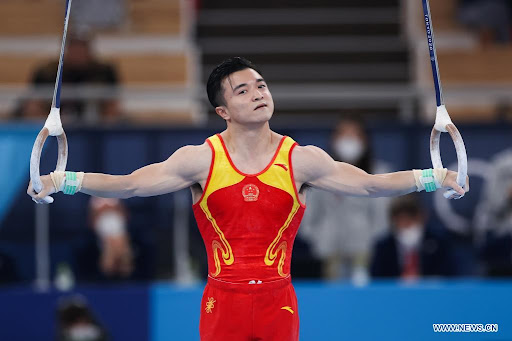
My favorite still rings specialist is the one with the best technique, 2020 Olympic champion Liu Yang of China.

How was your work perceived by the men’s gymnastics community?
Currently, the book has been mostly read and circulated among enthusiasts and practitioners of calisthenics. I hope that after this brief interview, it will also spread among gymnasts and coaches.
And how was it received by the Calisthenics community?
The calisthenics community has enthusiastically embraced this text. Many calisthenics athletes have been seeking a book dedicated to rings training for some time. Numerous readers have found the scientific approach typical of this book very interesting.
What were your top ways of getting non-believers to become interested in his book?
I believe this is one of the few books that addresses certain topics and can be very interesting for anyone passionate about artistic gymnastics and calisthenics. I think this text could be a pleasant surprise for many readers!
Any plans for other subjects related to men’s gymnastics?
In the future, I will publish new editions of this book with a particular focus on expanding the rehabilitation section. Additionally, I will include new training techniques and scientific research in the text.
The book is available on Amazon:
English ebook version: Amazon – English Version
Italian ebook version : Amazon – Italian Version
Italian paper version: Amazon – Italian Hard Copy
For more information on the scoring system in Men’s Artistic Gymnastics, please read Men’s Artistic Gymnastics: A Guide To The Scoring System


Leave a Reply