
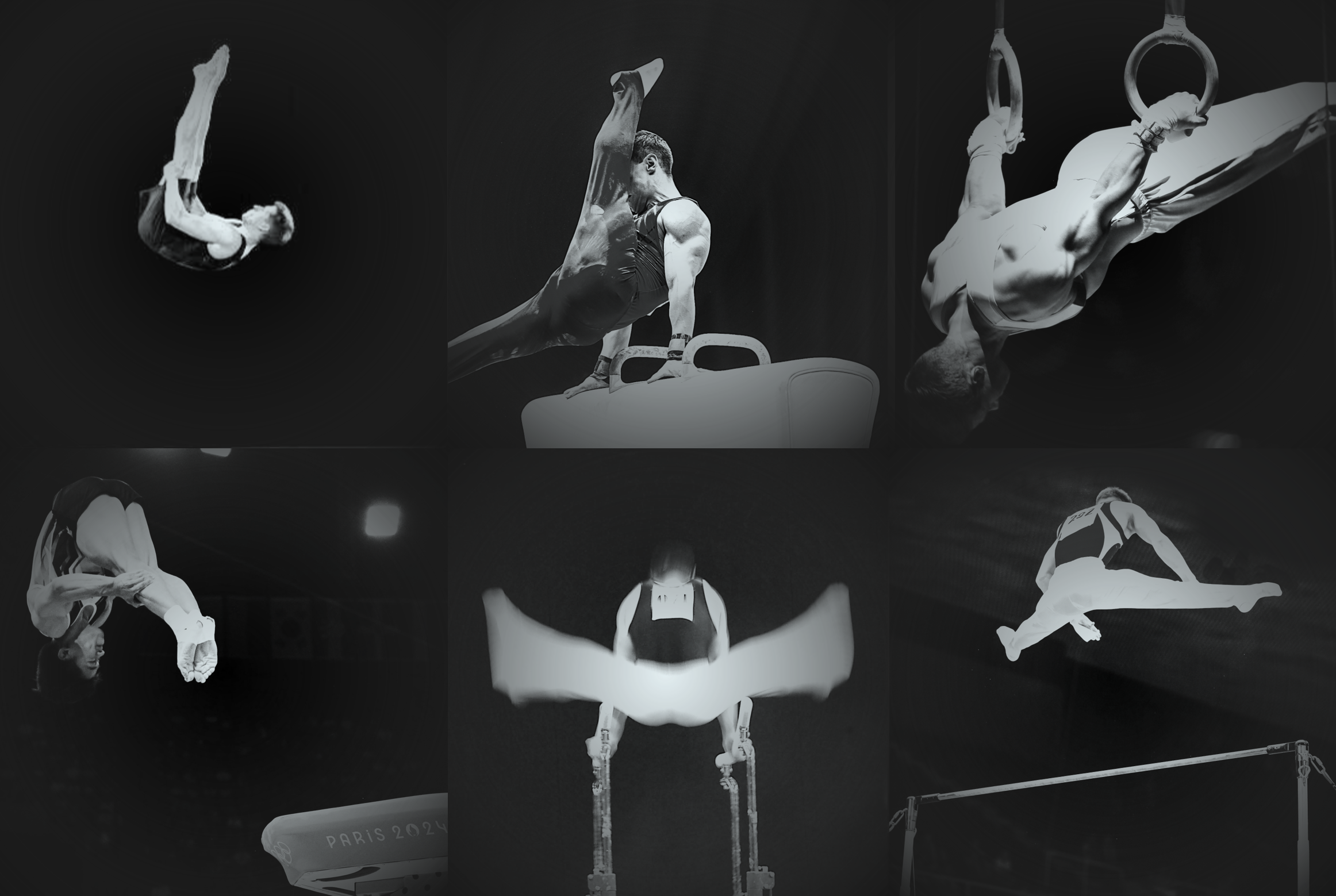
The All-Around in Gymnastics: The Art of No Weakness
- Why The All-Around Is The Hardest Title In The Sport
- Floor Exercise: Power Against The Line
- Pommel Horse: Rhythm Against Catastrophe
- Still Rings: Strength Made To Look Easy
- Vault: Gone In Six Seconds
- Parallel Bars: Precision The Eye Can Barely Read
- Horizontal Bar: The All-Or-Nothing Release
- Kōhei: The Variance That Never Came
The men’s individual All-Around is six routines in a single competition, on six apparatus that reward six different bodies, and it is almost never won by the best gymnast on any one of them. It is won by the man with no fatal weakness, and it is often lost on the event whose character is most hostile to him.
At Tokyo 2020, 2017 World Champion Xiao Ruoteng (CHN) led the All-Around going into the final rotation; Hashimoto Daiki (JPN) overtook him there on high bar, the most volatile apparatus on the programme, to take the title by four tenths at 19, the youngest champion in the event’s history.

Three years later in Paris, the same Hashimoto, by then the reigning Olympic and World AA Champion, fell off the pommel horse in the All-Around final and finished 6th. One gymnast, the two events with the least margin for error, opposite outcomes in two consecutive Games. And Xiao Ruoteng finished 3rd, 0.468 behind gold medalist Oka Shinnosuke (JPN).
Why The All-Around Is The Hardest Title In The Sport

ALL-AROUND
Complete enough everywhere to be beaten nowhere.
That is the premise here. Each men’s gymnastics apparatus has a character, defined by a single tension it forces the gymnast to negotiate, and the Code of Points is built to reward one side of that tension while punishing failure on the other. A routine is the resolution of that conflict, for six or seventy seconds.
The primacy of the All-Around is also a matter of history. Gymnastics was built in the 19th century as a project of complete physical development, a system for making the whole body capable rather than a stage for isolated feats, and the All-Around was simply the measure of how far that project had got in any one athlete.
The apparatus asked more similar things of a gymnast then than they do now. Elements were rudimentary, routines were short, and difficulty and execution existed only in embryonic form, weighed by a rough overall judgement rather than the itemised Code that governs scoring today. There was little to specialise in, so every competitor was an all-arounder by default. What changed was difficulty.
As the Code grew and skills escalated through the 20th century, each apparatus developed its own extreme and particular demands, the events drifted apart in what they rewarded, and specialisation became first possible and then, on the apparatus World Cup circuit and in event finals, worth building a career on. The complete gymnast went from the ordinary case to the rare one. The All-Around held on to its standing as the premier title because it still asks the question the discipline was invented to answer: not who is best on a single apparatus, but who is complete.
Set the six characters side by side and the conflict is obvious. The strength rings demands is dead weight on the rhythm pommel needs; the power floor and vault reward fights the line and stillness that rings and parallel bars require; the explosive release a high bar routine is built around is the opposite of the controlled continuity that keeps a pommel set alive.
The All-Arounder is the gymnast who reconciles six contradictions in one body across one competition without a weak event for the field to attack, which is why the title is the hardest in the sport and why the men who hold it, from Uchimura Kohei (JPN) to Hashimoto Daiki, are revered the way they are. Daiki is the case in miniature: lifted to the Tokyo title by the apparatus that rewards nerve, dropped from Paris contention by the one that punishes the smallest break. Six events, two of them with almost no margin, deciding the same man’s fate in opposite directions.
The All-Arounder has to resolve all six contradictions in two hours, in one body, which is why the events are best understood not as variations on a theme but as six different arguments about what a gymnast should be able to do. Taken in Olympic order – floor, pommel horse, rings, vault, parallel bars, high bar – here is what each one demands.
It also raises the obvious next question. If the six gymnastics apparatus reward physically opposite traits, what kind of body can plausibly attempt all of them, and how early is a young gymnast steered toward a single event or toward the All-Around? And how long until a gymnast drops the All-Around to focus on his best event(s)? That is a question of anthropometry.
Floor Exercise: Power Against The Line

Floor Exercise
Maximum power, kept inside the lines.
Floor is the only event judged purely on what the body does in open space, with nothing to hold and nowhere to hide. The tension is between the power that builds a difficulty score and the control needed to express it inside a twelve-metre square and a seventy-second clock.
Every tumbling pass is a maximal effort; the boundary line turns each one into a problem, because the more force a gymnast generates the harder it becomes to arrest it before the edge. Out-of-bounds steps are deducted, landings are scrutinised to the millimetre, and the routine still has to be filled with the turns, holds and transitions that men’s floor rarely gets credited for. It is an endurance event disguised as a power one.
Shirai Kenzo (JPN) redrew the ceiling here. The Japanese “Twist Prince,” a three-time world floor champion, normalised the quadruple twist and the triple-twisting double, forcing the rest of the field to chase twist counts that had been theoretical a decade earlier.
The current marker is Carlos Yulo (PHI), whose Paris 2024 floor title – the first Olympic gymnastics gold in Philippine history – came from a routine that paired that kind of difficulty with landings clean enough to survive the line under maximum pressure. Floor rewards the gymnast who can be violent and precise in the same instant.
Pommel Horse: Rhythm Against Catastrophe

Pommel Horse
Unbroken rhythm, impossible to recover once it breaks.
Pommel Horse is the wildcard, and the reason is structural rather than a matter of difficulty. It is the only apparatus built entirely on continuous circular momentum, with no held positions, no stops and no legal way to reset. The hands are the only contact, on a narrow curved surface, while the centre of mass travels without pause.
On rings a gymnast can settle into a strength element; on high bar they can regrip; on pommel the rhythm either survives or it collapses. A small spatial drift does not cost a tenth: it ends the circle. Errors are unrecoverable rather than incremental, which is why the apparatus carries the highest incidence of falls and is routinely called the balance beam of the men’s programme.
The skill vocabulary compounds the risk: Russian wendeswings, flairs, the travelling elements, combined work, and handstand dismounts, all packed into a routine with no margin. The modern lineage runs through Krisztián Berki‘s (HUN) London 2012 title, Max Whitlock‘s (GBR) back-to-back golds in Rio and Tokyo, the slight precision of Lee Chih-kai (TPE), and Rhys McClenaghan‘s (IRL) Paris 2024 gold.
The clearest illustration is the one that opened this piece: Hashimoto Daiki arrived at the Paris All-Around final as the reigning Olympic and World Champion and came off the horse mid-routine; a single break on the one apparatus that suits All-Arounders least dropped him from gold contention to sixth, and Oka Shinnosuke took the title. Pommel horse rewards specialisation so completely that a gymnast can build an entire Olympic selection on it and nothing else, which is exactly why the All-Arounder, who has no such luxury, fears the rotation more than any other.
Still Rings: Strength Made To Look Easy

Still Rings
The work is in hiding the work.
Rings is a negotiation between holding monstrous static shapes and not letting the body betray the effort of holding them. The iron cross, the Maltese, the inverted cross and the planche are the recognisable furniture, but the apparatus is most honest in what it reveals: a bent arm, a dropped angle, a sag, or a swing in the cables is visible to the eye and penalised by the Code.
The swing-to-hold transitions are where raw strength has to arrive at absolute stillness on the half-second. At the elite level the held positions are a given; what separates the field is whether the body trembles getting into them and whether it lands the dismount clean.
The historical spine is short and heavy. Albert Azaryan (URS/ARM) took consecutive golds in 1956 and 1960 and left his name on the cross element; Nakayama Akinori (JPN) did the same across 1968 and 1972; Yuri Chechi (ITA) dominated the 1990s as the Lord of the Rings. Paris 2024 added Liu Yang (CHN) to that company as only the third man ever to retain the Olympic title.
The detail that proves the apparatus, though, is the margin: Liu beat his teammate Zou Jingyuan (CHN) by 0.067, and the entire gap came on the double-double dismount, where Zou hopped and Liu did not. Both men’s strength positions were effectively flawless. Form on the landing decided an Olympic title.
Vault: Gone In Six Seconds

Vault
The shortest event in the sport, and the least forgiving.
Vault is the cruellest event because the whole of it is over in five or six seconds and is judged on a single explosive instant followed by a landing the gymnast frequently cannot see coming. There is no second act inside the vault and no way to recover a flawed entry; in the event final, the two vaults must come from different groups and are averaged, so one mistake halves the day.
The Yurchenko and Tsukahara entries rotate away from the mat, so the gymnast is committing enormous difficulty into a blind finish. Run-up, board, a flash of contact, flight, stick, the difficulty packed into that window is immense and the room to express it is almost nothing.
The event is defined by its innovators, who tend to get their names attached to the vaults themselves. Marian Drăgulescu (ROU) spent two decades as the event’s great showman and left his own vault in the Code. Yang Hak-seon (KOR) won London 2012 with the handspring triple-twist that now bears his name; Ri Se-gwang (PRK) built the highest-difficulty programme of his era on the way to Rio 2016. Carlos Yulo‘s (PHI) Paris 2024 title, his second gold of those Games, marked the current standard, the same blend of difficulty and landing control that floor demands, but with a tenth of the time to find it.
Parallel Bars: Precision The Eye Can Barely Read

Parallel Bars
Errors too small for the camera, big enough for the judges.
Parallel bars is the connoisseur’s gymnastics apparatus, and its tension is partly with the audience. Many of its elements look alike, so it rewards a precision the casual viewer cannot even see: the absence of an arm bend, a handstand held dead vertical, a millimetric line through a turn.
The event balances work in the support position: presses, Diamidov turns, handstands against the swinging and release work below and around the rails, the peach baskets and underbar catches. Its mastery is legible to judges and specialists and almost invisible on a broadcast, which is precisely why it produces the cleanest gymnastics in the programme and the least televisual.
Its lineage is a lineage of stylists: Rustam Sharipov‘s (UKR) range in the 1990s, Li Xiaopeng‘s (CHN) two Olympic titles, and now Zou Jingyuan (CHN), who has turned the event into a demonstration of near-mechanical execution and taken the individual title in both Tokyo and Paris.
The benchmark is quiet by the standards of this list: Zou posts the highest execution scores in the world and wins by margins that turn the final into a procession. On most apparatus a routine that decisive is loud. On parallel bars it is simply a man not making a single visible error. Although Zou Jingyuan rarely participates in the All-Around, his perfect routines establish a standard for excellence across all competitions.
Zou Jingyuan has maintained an average execution score of 9.114 in this event since 2017. In a discipline where attaining a score of 9.000 on any apparatus, excluding the vault, has become progressively uncommon over the past decade, his accomplishment establishes a notably high standard for fellow gymnasts.
Horizontal Bar: The All-Or-Nothing Release

Horizontal Bar
All spectacle, no safety net, saved for last.
High bar is the crowd’s apparatus because its defining elements are binary. The release-and-catch families (Tkatchev, Kovacs, Gaylord, Winkler, Liukin, Def,…) leave the gymnast airborne and momentarily blind, and the result is simply catch or fall, in front of everyone. Connecting releases directly, rather than rebuilding swing between them, multiplies the risk geometrically, and the dismount, a double-double or a triple back, is the routine’s climax by design. No event produces bigger ovations, and none produces more public disasters. Remember the event finals at the Tokyo and Paris Olympics and how many gymnasts fell…
The same binary that crowns a champion can erase a medal in a single airborne instant: an All-Arounder who leads after five events can lose everything to one missed catch in the last rotation, which is precisely why high bar, coming last in the order, so often delivers the final verdict on the All-Around itself. David Belyavskiy (RUS) missed the podium at the 2017 World Championships in Montréal because of a fall on an easier element (the Yamawaki).
Igor Cassina (ITA) took Athens 2004 and left his name on the bar. Fabian Hambüchen (GER) finally converted years of near-misses into gold at Rio 2016. The apparatus’s signature performance belongs to Epke Zonderland (NED), the Flying Dutchman, whose London 2012 title was built on connecting three release elements – the Cassina, the Kovacs and the Kolman – in immediate succession, something that had never been done at the Olympics.
Kōhei: The Variance That Never Came
Between 2009 and 2016, Uchimura Kōhei (JPN) won the individual All-Around eight consecutive times: six World titles and two Olympic golds, a run no gymnast of either sex has matched. The margins say more than the count. He took his first World title in 2009 by more than two and a half points, and his third in 2011 by over three, a gap as wide as the one separating second place from fourteenth. For most of that decade he was not edging the field. He was removing it.

What set him apart was not difficulty but its opposite. His guiding idea, inherited from his father, was that a hundred imperfect movements are worth less than one done beautifully, and he built his all-around on execution and repeatability rather than on the biggest D-scores in the room. That is the trait this whole piece keeps circling. The All-Arounder’s enemy is variance, the one bad apparatus that sinks a winning day, and Kōhei’s gift was that the bad apparatus almost never arrived.
He reached event finals too, taking world floor gold in 2011 and medals on parallel bars and high bar, so this was not mere survival across six events. But his signature was the All-Around itself, the refusal to leave the field any opening anywhere. Even his narrowest win, the 0.099 over Oleg Verniaiev (UKR) at Rio 2016, came down to the last high bar routine of the night, the nerve apparatus, where he held and the other man played it safe.
Injuries ended the run after Rio. Unable to carry six events any longer, Kōhei narrowed to one, the high bar, and qualified for a home Olympics in Tokyo as a specialist, only to slip off the bar in the qualifying round and go out without reaching a final.
His last competition took place at the 2021 World Championship in his birthplace of Kitakyushu, where he successfully qualified for the High Bar final, although he did not achieve a medal.
The greatest All-Arounder in the sport’s history finished as a one-apparatus gymnast, pulled in the end toward the same specialisation that shapes nearly every career but his own. Which is exactly the question the companion piece takes up: what kind of body can attempt all six at once, and why almost everyone else is steered, sooner or later, toward a single event. For eight years, the art of no weakness had one name.
Understanding MAG:
Men’s Artistic Gymnastics at the 2024 Olympics
2024 Olympic All-Around Final Results: Japan On Top
All-Around in Gymnastics All-Around in Gymnastics All-Around in Gymnastics All-Around in Gymnastics All-Around in Gymnastics All-Around in Gymnastics All-Around in Gymnastics All-Around in Gymnastics All-Around in Gymnastics All-Around in Gymnastics All-Around in Gymnastics All-Around in Gymnastics All-Around in Gymnastics All-Around in Gymnastics All-Around in Gymnastics All-Around in Gymnastics All-Around in Gymnastics All-Around in Gymnastics All-Around in Gymnastics All-Around in Gymnastics All-Around in Gymnastics All-Around in Gymnastics All-Around in Gymnastics All-Around in Gymnastics All-Around in Gymnastics All-Around in Gymnastics All-Around in Gymnastics All-Around in Gymnastics All-Around in Gymnastics All-Around in Gymnastics All-Around in Gymnastics All-Around in Gymnastics All-Around in Gymnastics All-Around in Gymnastics All-Around in Gymnastics All-Around in Gymnastics All-Around in Gymnastics All-Around in Gymnastics All-Around in Gymnastics All-Around in Gymnastics



Leave a Reply