
2025-2028 MAG COP Update: New Rules Explained
A 2025-2028 MAG COP update was released by the FIG’s Technical Committee in a newsletter in early August 2025. The main change concerns the Floor Exercise and rules about the inclusion of “choreography & artistry” in routines; however, the FIG’s Technical Committee has also introduced minor modifications regarding the other apparatuses, with the exception of the Vault.
2025-2028 MAG COP Update: Floor Exercise
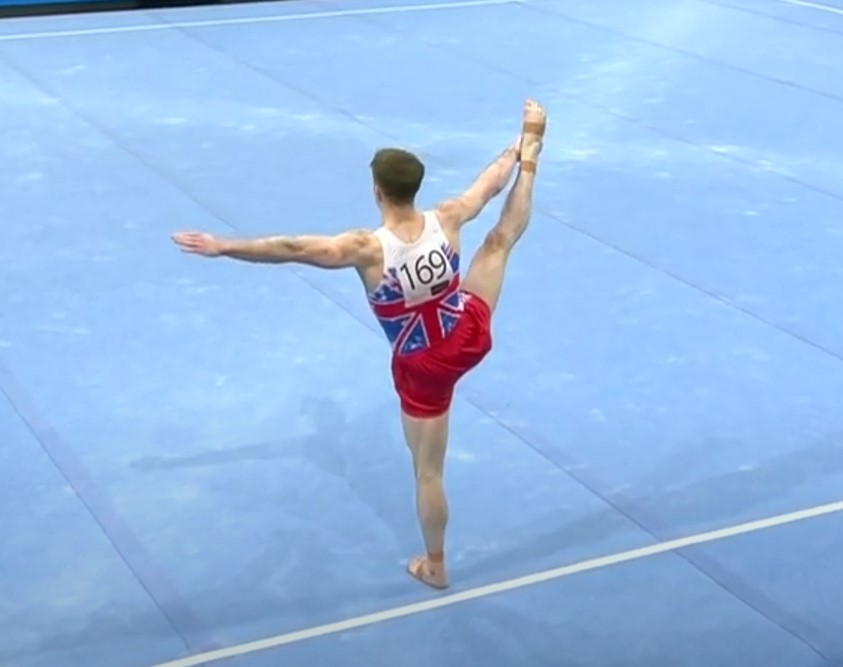
When the latest MAG Code of Points was released last year, one rule in particular attracted the attention: the compulsory inclusion of a one-leg balance element in Floor routines. Those who remember the routines from the 1970s to the 1990s have experienced a form of nostalgia, but the gymnasts competing today were undoubtedly taken aback by this new rule, as they are not accustomed to this form of exercise. The FIG’s Technical Committee has therefore taken into account the feedback from athletes, coaches, and judges, and has decided to modify this rule.

“All the things I could do if I was as flexible as Yuri Balabanov” – Anonymous spectator
The FIG’s Technical Committee objective was to integrate acrobatic elements in FX routines with various gymnastic components such as strength, balance, flexibility, handstands, and choreographic combinations, in order to create a cohesive rhythmic exercise. Including the one-leg balance element was not an end in itself.
The update of the rule will allow gymnasts to select skills that align with their abilities, “that lend themselves to his favored ability, whilst at the same time encouraging choreographic combinations that show harmonious rhythm between tumble passes, will ultimately improve the overall balance and appeal of the floor exercise.”
In the updated MAG Code of Points, gymnasts must now include either a one-leg balance element or a jump/leap, with or without a turn (see list below). Like in the previous version, this “extra” element may exceed the designated eight counting elements and 0.3 point will be deducted if not performed.
NEW EG 1 ELEMENTS TO CHOOSE FROM
EG 1.67 Jump bwd. to front support
EG 1.68 Jump bwd. with pike-stretch or with 1/1 turn to front support (Endo)
EG 1.74 Butterfly with 1/1 twist fwd. or bwd. (Tong Fei)
EG 1.75 Butterfly with 2/1 twist
EG 1.15 Jump fwd. with 1/1 turn to front support (to be included)
EG 1.16 Jump bwd. with 3/2 twist to front support (to be included)
EG 1.17 Jump fwd. with 2/1 twist to front support (to be included)
EG 1.43 Jump fwd. with ½ turn to momentary handstand (to be included)
EG 2.8 Dive roll with 1/1 twist (to be included)
EG 1.73 Stag Leap with 1/1 turn (to be included)
Gymnasts who dread the thought of balancing on one leg can now embrace their inner acrobat with some snazzy alternatives: jumps, the Tong Fei, or the dive-roll and the Endo with a twist (although – spoiler alert – for the Endo, they still need to land on their hands and gracefully drop into a front support). Eventually, the era of pink flamingos in leotards might be taking a backseat as gymnasts scramble for more dynamic moves that look less like a stork audition and more like something they actually enjoy, or already master. And please note, if anyone thinks of ditching that non-acro element at the start of their routine, watch out for the 0.3 deduction lurking around the corner.
Furthermore, if the goal is to bring more choreography and artistry to the Floor exercises, it is undoubtedly preferable to have a choice of a dozen elements rather than imposing a single type of element, which tends to break the rhythm of the routine.
“THAT’S ME IN THE CORNER…”
The FIG’s Technical Committee meticulously evaluated the crucial subject of “corner transitions,” expressing concern over the issues of inadequate execution and the detrimental repetition associated with these movements. In response to these concerns, the Committee imposes the following changes with immediate effect in the MAG Code of Points:
– Choreographic leaps and turn combinations should be used, specifically in the corners, to create harmonious rhythm between tumbling passes.
– Simple steps, with or without 180° turn, will attract a small deduction for lack of artistry.
– All choreographic leaps, jumps and turns must show amplitude and appropriate extension or will be deducted with a small error.
– In 2026, all corner transitions must be different or will attract a 0.3 neutral deduction taken by the D jury.
I understand the FIG’s initial goal of reintroducing the one-leg balance element; however, after six months, it is evident that this addition has not significantly enhanced the routines of gymnasts who would not have included it if they were not required to do so. Rather than fostering diversity, it has once again resulted in a homogenization of routines. As long as the incorporation of “artistry” or “choreography” remains a mandatory requirement, I don’t think that it will genuinely elevate the quality or the diversity of the routines.
Penalty vs. Incentive
Instead of imposing deductions, the FIG’s Technical Committee ought to consider awarding bonuses: for instance, if a gymnast performs a leap, a jump, or another element within a subcategory of the EG1, they should receive a +0.3 bonus rather than incurring a 0.3 deduction for its omission. Many gymnasts are uncomfortable with these skills, and numerous athletes competing in elite gymnastics today did not envision such elements when they began their journey as children.
It is my understanding that audiences generally appreciate the performances that occur between tumbling passes; however, introducing a punitive rule in lieu of an incentive will not automatically motivate gymnasts.
Last year, a provisional version of the 2025-2028 MAG COP Update was released and included a “required choreography sequence from list to be defined“. Eventually, the final version of the 2025-2028 COP only featured the one-leg balance element, but the Technical Committee’s update shows that they were seriously considering implementing choreography in the early drafts of the latest COP.
Gender stereotypes?
The news triggered some heated debates within the gymnastics community (see article linked below): proponents emphasize the importance of artistic expression and audience engagement, while detractors voice concerns regarding execution challenges and consistent judging standards. Also the argument “people already think that gymnastics is a girl’s sport” was heard: a lot of male gymnasts spend their lives debunking this stereotype and showing that their sport is as virile as football. Regardless of progressive perceptions, throwing in some choreography or dance moves might not sit well with them; many countries remain influenced by “traditional” gender norms.
Heath Thorpe, a pioneer in terms of incorporating choreography, jumps, or turns into men’s floor routines, does not advocate for the inclusion of these sequences at any cost: he is aware that each gymnast is unique and not necessarily inclined to integrate elements that he enjoys but that are not universally popular among male gymnasts.

Eventually, the final version of the 2025-2028 Code of Points only featured the implementation of the one-leg balance element, but the Technical Committee’s update shows that they were seriously considering implementing choreography in the early drafts of the latest COP.
Other changes in the MAG Code of Points
– SPINDLE TO HANDSTAND (EG1-93 & EG1-100) : To be recognized as one individual element, the Spindle must be performed within a maximum of 2 circles (3 front support positions from the original start position). For elements EG1-93 and EG1-100, this rule is further clarified that the gymnast does not have to achieve the 3rd front support position because they will be rising handstand during that phase.
– JUDGING: In order to gain consistency and simplify judging across the apparatus from 1st January 2026, the D jury will first count the dismount before then counting the next 7 highest elements.
– MANNA AND V-SIT: A perfect Manna position is where the legs are horizontal. If the legs are up to 30° short of horizontal, there will be a 0.1 or 0.3 deduction. All other leg positions up to vertical will be evaluated as a V-sit with no deduction. If the legs are short of vertical up to 15° is 0.1, > 15° to 30° is 0.3 deduction. More than 30° is non-recognition.

2025-2028 MAG COP Update: Pommel Horse
– SCISSOR RECOGNITION: In the case of scissor elements, where the gymnasts supports themselves with their leg before completing the element, the element will not be recognized and they will receive a 0.5 deduction for interruption of exercise without a fall. Scissor elements may be recognized if there is a small arm bend, or slight touching of the horse, with a 0.1 deduction for each.
– BERTONCELJ TO SIDE SUPPORT: The Bertoncelj may be performed to either cross support or side support on one pommel. Therefore, a Bertoncelj to side support on one pommel may begin a flop or combined sequence.
2025-2028 MAG COP Update: Rings
SWING TO HANDSTANDS:
5 elements fulfill the swing to handstand requirement:
1. EG I.75 Swing fwd. to handstand or giant swing bwd. to handstand (2 s.)
2. EG I.81 Uprise bwd. to handstand or giant swing fwd. to handstand (2 s.)
3. EG I.86 From support swing bwd. to handstand (2 s.)
4. EG I.87 Honma and swing bwd. to handstand (2 s.)
5. EG I.88 Honma straight and swing bwd. to handstand (2 s.)
2025-2028 MAG COP Update: Parallel Bars
GATSON STYLE ELEMENTS:
From support or upper arm, swing backward with hop 3/4, 1/1, or 3/2 turn to handstand must be performed with flight. These include elements EG2-82, EG2-83, EG2-84, and EG1-41. These elements must be performed with at least 3/4 of the turn performed in flight before regrasping of the first arm. Gatson style elements performed with a lack of flight will not be recognized for difficulty.
2025-2028 MAG COP Update: Horizontal Bar
– START OF THE EXERCISE:
A cast, consisting of a maximum of three swings, is permitted in order to begin an exercise without deduction. Each movement forward and/or backward counts as a swing. Further, either a jump to a swing or a coach pushing the gymnast into a swing counts as a swing.
– GRIP CHANGES:
An additional grip change is considered an “additional or intermediate hand support” and will be deducted 0.1 each time.
Examples:
– Zou Li Min to mixed grip followed by an immediate grip change will be deducted 0.1, but the Zou Li Min is recognized.Endo, Kip or Uprise backward with overgrip followed by two consecutive grip changes to undergrip will be deducted 0.1 for the second grip change
– Adler 1/1 turn to mixed grip followed by an immediate grip change to undergrip will be deducted 0.1.
– Elements in mixed grip (giant forward, Endo, Uprise backward, Kip etc.) followed by one grip change to undergrip will not receive a deduction.
– UPRISE BACKWARD TO FREE HIP CIRCLE:
As a mount, if a gymnast performs an uprise backward to support, followed by a free hip (or other movement), they will receive a 0.3 deduction for reversal of direction. If no support is shown during the swing rearward, there will be no deduction. Support is when the arm angle is less than 45° from arm to body.
– KOVACS STYLE ELEMENTS:
A salto bwd. with ½ turn over the bar (EG2-82) and Gaylord 2 (EG2-83) are considered as Kovacs style flight elements when applying the special repetition rule, which allows a maximum of two elements of each flight style.
– FIVE FLIGHT ELEMENTS:
The gymnast may perform a 5th flight (EG II) among the 7 counting elements if at least two flights are directly connected (minimum C+C).
2025-2028 MAG COP Update: New Elements

POMMEL HORSE
The “Moore“
Bertoncelj to Busnari
Rate: G (EG2-60)
Performed by Jesse Moore (AUS) at the 2025 Doha World Cup

VAULT
The “Olfati“
Yurchenko and salto bwd tucked with 1/1 turn
Rate: 5.6 (Vault #522)
Performed by Mahdi Olfati (IRI) at the 2025 Asian Championships

PARALLEL BARS
The “Hall“
5/4 salto fwd straddled w. ½ turn to upper arm
Rate: E (EG2-95)
Performed by James Hall (GBR) at the 2025 Doha World Cup
Source: FIG MAG Newsletter – August 2025



Leave a Reply