
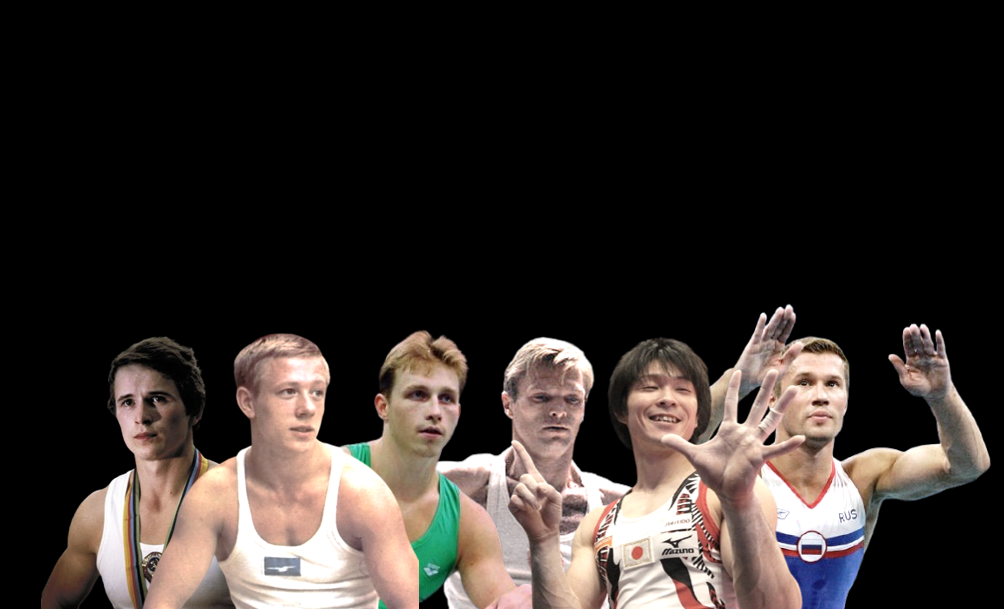
The 50 best male gymnasts in history
The best male gymnasts since 1948
After the 2024 Paris Olympic Games, let’s see how the results impacted the rankings of the most decorated gymnasts. One year ago, I posted the list of the most decorated male gymnasts at the Olympic Games and at the World Championships based on medal counts.
The 50 best male gymnasts based on their medal counts at the Olympic Games and World Championships since 1948. Out of the 600 gymnasts who won at least 1 medal, which gymnasts are in the top 50?

How we selected the 50 best male gymnasts…
WHEN?
Since 1948: 19 Olympic Games and 41 World Championships
The format of the competitions before World War II differed significantly, incorporating apparatuses that are no longer utilized, such as rope climbing or tumbling.
WHO?
Based on the 604 gymnasts who have won a medal at the Olympics and/or at World Championships since 1948 in Teams, All Around or Event finals
Because of ties and the fluctuating number of athletes per teams, 604 gymnasts have secured at least one medal at the Olympics or World Championships, including those who participated in Paris.
HOW?
Not all medals hold the same value; hence, a points-based bonus system has been established:
1/ Olympic medal bonus: +2 points
2/ All Around medal bonus: +2 points
3/ Individual apparatus medal bonus: +1 point
Consequently, a silver medal obtained on the Pommel Horse at the World Championships is valued at 2+1=3 points. A gold medal in the All Around at the Olympics is valued at 3+2+2=7 points.


Rankings of the 50 best male gymnasts
Currently competing gymnasts identified in bold
*Deceased gymnasts
| RANK | GYMNAST | NOC | YEARS | OG MEDALS | WC MEDALS | TOTAL POINTS |
|---|---|---|---|---|---|---|
| 1 | Vitaly Scherbo | URS / BLR | 1989-1997 | 10 | 23 | 133 |
| 2 | Nikolai Andrianov* | URS | 1970-1980 | 15 | 13 | 119 |
| 3 | Boris Shaklin* | URS | 1956-1964 | 13 | 14 | 109 |
| 4 | Kohei Uchimura | JPN | 2007-2021 | 7 | 21 | 107 |
| 5 | Alexey Nemov | RUS | 1993-2004 | 12 | 13 | 95 |
| 6 | Akinori Nakayama* | RUS | 1965-1972 | 10 | 12 | 94 |
| 7 | Eizo Kenmotsu | JPN | 1968-1979 | 9 | 15 | 91 |
| 8 | Alexander Dityatin* | URS | 1976-1980 | 10 | 12 | 90 |
| 9 | Takashi Ono | JPN | 1952-1964 | 13 | 7 | 88 |
| 10 | Viktor Chukarin* | URS | 1952-1956 | 11 | 4 | 75 |
| 11 | Yuri Titov | URS | 1958-1964 | 9 | 9 | 71 |
| 12 | Sawao Kato | JPN | 1968-1977 | 12 | 1 | 70 |
| 13 | Vladimir Artemov | URS | 1983-1989 | 5 | 13 | 70 |
| 14 | Mikhail Voronin* | URS | 1966-1972 | 9 | 7 | 69 |
| 15 | Yukio Endo* | JPN | 1960-1968 | 7 | 9 | 68 |
| 16 | Dmitry Bilozerchev | URS | 1983-1988 | 4 | 12 | 66 |
| 17 | Mitsuo Tsukahara | JPN | 1968-1978 | 9 | 6 | 65 |
| 18 | Li Xiaopeng | CHN | 1997-2009 | 5 | 11 | 63 |
| 19 | Yang Wei | CHN | 1999-2008 | 5 | 10 | 62 |
| 20 | Grigory Misutin | URS / UKR | 1991-1996 | 6 | 9 | 60 |
| 21 | Li Ning | CHN | 1983-1989 | 6 | 11 | 59 |
| 22 | Jordan Jovchev | BUL | 1992-2013 | 4 | 10 | 50 |
| 23 | Max Whitlock | GBR | 2010-2024 | 6 | 8 | 57 |
| 24 | Zou Kai | CHN | 2006-2014 | 6 | 7 | 55 |
| 25 | Daiki Hashimoto | JPN | 2019- | 4 | 10 | 55 |
| 26 | Josef Stadler* | SUI | 1948-1952 | 7 | 0 | 52 |
| 27 | Koji Gushiken | JPN | 1979-1985 | 5 | 10 | 51 |
| 28 | Masao Takemoto* | JPN | 1952-1960 | 7 | 7 | 50 |
| 28 | Lou Yun | CHN | 1983-1988 | 5 | 8 | 50 |
| 28 | Andreas Wecker | GDR / GER | 1988-2000 | 5 | 10 | 50 |
| 28 | Marian Drăgulescu | ROM | 1999-2021 | 3 | 10 | 50 |
| 32 | Chen Yibing | CHN | 2005-2012 | 4 | 8 | 49 |
| 32 | Li Xiaochuang | CHN | 1992-1997 | 6 | 6 | 49 |
| 34 | Valentin Muratov* | URS | 1952-1958 | 5 | 6 | 48 |
| 35 | Zou Jingyuan | CHN | 2017- | 5 | 7 | 47 |
| 36 | Igor Korobchinski | URS / UKR | 1989-1998 | 3 | 11 | 47 |
| 37 | Shigeru Kasamatsu | JPN | 1972-1979 | 4 | 8 | 46 |
| 37 | Li Jing | CHN | 1989-1994 | 3 | 11 | 46 |
| 37 | Yuri Korolev* | URS | 1981-1989 | 0 | 13 | 46 |
| 40 | Xiao Ruoteng | CHN | 2015- | 5 | 8 | 45 |
| 41 | Denis Ablyazin | RUS | 2011-2024 | 7 | 4 | 44 |
| 42 | Heikki Savoianen* | FIN | 1928-1956 | 9 | 2 | 43 |
| 43 | Kenzo Shirai | JPN | 2013-2021 | 2 | 11 | 42 |
| 44 | Alexandr Tkachev | URS | 1977-1981 | 3 | 9 | 41 |
| 44 | Michael Reucsh* | SUI | 1938-1948 | 5 | 5 | 41 |
| 46 | Shuji Tsurumi | JPN | 1960-1966 | 6 | 0 | 40 |
| 47 | Albert Azaryan | URS | 1953-1960 | 4 | 5 | 38 |
| 47 | Fabian Hambüchen | GER | 2003-2016 | 3 | 9 | 38 |
| 47 | Xiao Qin | CHN | 2001-2008 | 2 | 8 | 38 |
| 50 | Liu Yang | CHN | 2013- | 4 | 7 | 37 |
Some Insights
Longest careers
Heikki Savolainen (FIN): 24 years (1928-1952)
He competed at 5 Olympic Games between 1928 and 1952 and retired from men’s artistic gymnastics at age 45. He became a Doctor in Medicine in 1939 and during the war, and served with the rank of lieutenant colonel as the head doctor in a military hospital. He’s the only gymnast in this list, who won medals before 1948.
Marian Drăgulescu (ROU): 22 years (1999-2021)
He started his senior career in 1999 and took part to all Olympic Games between 2000 and 2020, except 2012.
Yordan Yovchev (BUL): 21 years (1991-2012)
He’s record holder for the highest number of participations to the Olympic Games (6 from 1992 to 2012)
Gymnasts who won the most medals at the same competition
Nikolai Andrianov (URS):
He won the most medals at the 1976 Olympics with 7 medals and one team medal and holds the record for the most Olympic medals at 15 (7 gold medals, 5 silver medals, 3 bronze medals) in men’s artistic gymnastics. He achieved an Olympic medal in all Olympic competitions in Men’s Artistic Gymnastics (MAG), with the exception of the horizontal bar.
Vitaly Scherbo (URS/CIS/BLR):
He is the sole gymnast in history to have secured a world title across all 8 MAG competitions (Teams, All-Around, Floor Exercise, Pommel Horse, Still Rings, Vault, Parallel Bars, and Horizontal Bar). During the 1992 Olympics, he attained only gold medals, clinching titles in 6 events (All-Around, Teams, Pommel Horse, Rings, Vault, and Parallel Bars).
In summary, he has no silver medals among his 10 Olympic accolades.
Yuri Korolev (URS):
He is recognized as the most decorated non-Olympian in men’s artistic gymnastics, being the highest-ranked gymnast who has not won an Olympic medal. In 1980, he was too young to compete, while in 1984, the Soviet Union boycotted the Los Angeles Games, and in 1988, despite three remarkable participations at the World Championships, he failed to qualify for the Soviet team for the Seoul Games. As a result, he is ranked 39th in the list of the 50 best male gymnasts, owing to his impressive achievement of 13 medals at the World Championships.
Who’s next?
After the Paris Olympics, two gymnasts entered the list of the 50 best male gymnasts: Chinese gymnasts Zou Jingyuan and Liu Yang kicked Miroslav Cerar (YUG) and Marius Urzică (ROU) out of the Top 50 of the best male gymnasts. According to current rankings, the next still competing gymnasts, who could potentially reach the Top 50 are*:
- Artur Dalaloyan (RUS) – currently 56th **
- Kazuma Kaya (JPN) – currently 67th
- Carlos Yulo (PHI) – currently 68th
- You Hao (CHN) – currently 71st
- Eleftherios Petrounias (GRE) – currently 74th
- Oleg Verniaiev (UKR) – currently 76th
- Zhang Boheng (CHN) – currently 85th
- Lin Chaopan (CHN) – currently 88th
- David Belyavskiy (RUS) – currently 97th **
- Shinnosuke Oka (JPN) – currently 100th
* Some of the gymnasts listed may announce their retirement soon
** Russia is currently not allowed to compete in international competitions organized by the UEG (European Union of Gymnastics). No change has been announced at the beginning of this new Olympic cycle.

#1
Source: AFP

#2
Source:- AFP

#3
Source: Sputnik Mediabank

#4
Source: Sputnik Mediabank

#5
Source: AFP

#6
Source Jiji

#8
Source: TASS

#19
Source: Reuters

#22
Source: Svetoslav Kodjamanov

#23
Source: Naomi Baker / Getty

#25
Source: Getty

#48
Source: VCG
CONTEXT, PRINCIPLES AND INFORMATION
Here are several factors to consider when interpreting the ranking of the best male gymnasts and understanding the reasons behind the notable achievements of these athletes from the 1960s to the 1990s in the rankings:
– Between 1948 and the mid-1990s, a significant majority of medals were secured by gymnasts from three or four countries, predominantly the Soviet Union, Japan, and later, China.
– The regulation limiting each country to two athletes per event was nonexistent, which permitted 3 gymnasts from the same country to compete in both the All-Around and Events finals.
– Until 1978, the World Championships were held every four years.
– The scoring system and the Men’s Artistic Gymnastics Code of Points were not as advanced as they are today.
– Since the 2000s, attaining six or eight medals in a single championship has become notably more challenging for gymnasts. Even Kōhei Uchimura, who is widely regarded as one of the greatest gymnasts of all time, achieved fewer medals compared to his predecessors, despite winning the Men’s Artistic Gymnastics All-Around competitions eight times between 2009 and 2016. This trend can be attributed to the rise of specialists in the apparatus finals, who focus exclusively on one or two apparatuses, thereby significantly intensifying the competition.
Additionally, I calculated the rankings using the principle of “1 medal” equating to “1 point,” resulting in minor variations in the rankings while retaining the same gymnasts’ names, albeit in a different order.
More here: FIG website



Leave a Reply