

20 thought-provoking rules in the Men’s Gymnastics Code of Points
Highlighting the dynamics at play
The Men’s Artistic Gymnastics Code of Points comprises a comprehensive set of regulations that must be adhered to by gymnasts, coaches, judges, and the FIG’s Technical Committee. These regulations delineate the rights and responsibilities of all individuals involved in the competitions. While some of these regulations may be less familiar, others have emerged from past controversies, and some are notably unexpected.

Raising the Bar
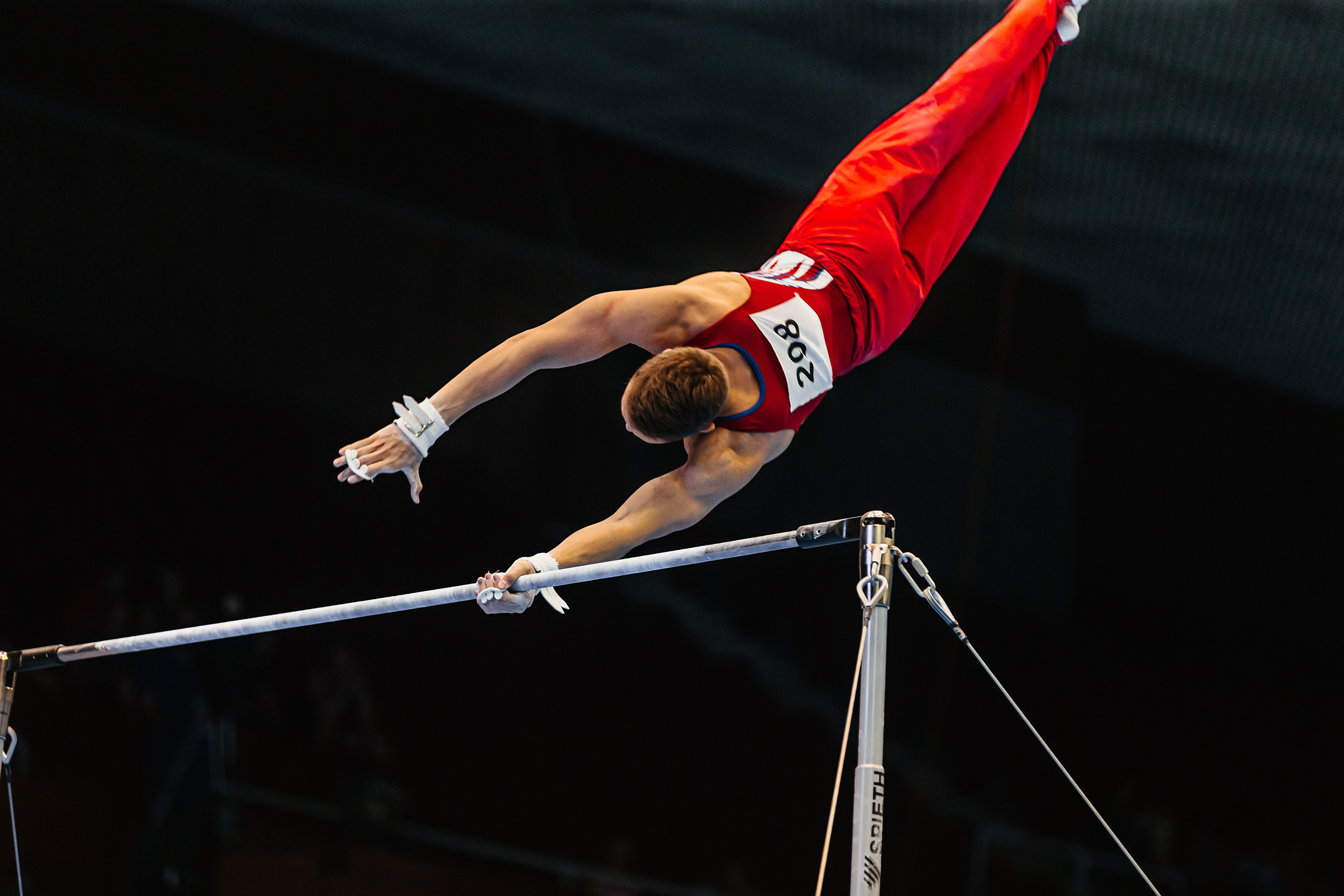
The specifications of each apparatus are distinctly articulated and remain immutable. However, tall gymnasts may formally petition for the elevation of the horizontal bar to suit their stature. A designated team of technicians will adjust the bar during the competition, whilst the gymnast wait for it to be ready. This is usually requested by gymnasts who are 1m80 and over (5’9).
On Repeat
Gymnasts are allowed to repeat the entire exercise (on rings or horizontal bar only) without deduction at the end of the rotation with approval by the D-Jury, if the gymnast shows a significantly torn hand-guard (grip) causing a fall or exercise interruption. It happened to Félix Dolci (CAN) at the 2024 Olympics.
30 Seconds to Bars
Gymnasts are not allowed to keep the judges waiting: they must begin their exercise within 30 seconds of the green light or signal from D1 judge (on all apparatuses).
Final Countdown
According to the Men’s Artistic Gymnastics Code of Points, gymnasts are required to remount within 30 seconds following a fall, with the timing commencing once the gymnast is on his feet after the fall. During this interval, the gymnast is permitted to recuperate, re-chalk, consult with their coach, and initiate their remount.
Should a gymnast purposefully remain off their feet to delay the start of the 30-second countdown, such as resting, adjusting grips, receiving chalk from the coach, or postponing the competition without valid justification, they may incur a penalty of 0.3 points.
Shorts vs. Trousers
The Men’s Gymnastics Code of Points decides what you’re allowed to wear: gymnasts have to be clothed in gymnastics pants for pommel horse, rings, parallel bars and horizontal bar. For floor and vault, gymnasts are permitted to wear long pants OR short pants, with or without socks. Historically, prior to the 1980s, it was common for gymnasts to wear trousers during these 2 events. However, since that time, it has become standard practice for all gymnasts to wear shorts in these two disciplines. Consequently, when competing in the teams Final or the All-Around, gymnasts change their attire following their performances on the horizontal bar and rings to prepare for the subsequent apparatuses.
True Colors
The FIG’s Men’s Artistic Gymnastics Code of Points is like the fashion police, deciding what colors are cool and what’s not: long pants, socks, or slippers that are in in black, or darker shades of blue, brown, or green are not allowed.
Salute
Failure to acknowledge the judges before or after the exercise may result in a penalty of 0.30 points. During the 2020 Olympic Games, Xiao Ruoteng (CHN) received a deduction of 0.3 points on horizontal bar in the All-Around competition, as he did not stand at attention to indicate the completion of his performance. The Chinese Federation submitted an appeal; however, it was ultimately rejected.
He secured the silver medal, finishing with a margin of 0.4 points behind the gold medalist, Hashimoto Daiki (JPN). Even if the inquiry had been accepted, Xiao Ruoteng would still be in second place. This occurrence, along with Hashimoto Daiki’s score on vault, ignited significant controversy in China, where media outlets, as well as athletes and artists, questioned the impartiality of the judging panel, alleging favoritism toward the host nation, Japan.
Hashimoto Daiki and Xiao Ruoteng both scored 14.700 on vault, although the Japanese gymnast stepped out of bounds. The FIG issued a statement following the competition, clarifying that the judging was conducted fairly and accurately for this exercise: a deduction of 0.3 was applied for the substantial footstep on landing, and a 0.1 penalty was enforced for the right foot stepping out of bounds.
White Powder
Don’t play with the chalk and don’t intentionally break the equipment: incorrect use of chalk, damaging the apparatus, including spraying (except on Parallel Bars) can lead to a 0.50 penalty. (I don’t really know what an incorrect use of chalk can be; maybe the FIG thinks that athletes may start a chalk fight in the middle of a competition).
Medal Ceremony
If you find yourself lucky enough to snag a medal, do yourself a favor and hop up onto that podium to claim your prize. The men’s artistic gymnastics Code of Points is very serious about this: being absent from the Medal Ceremony leads to the annulment of the final result and score for the team or the individual gymnast by the judges.
Don’t Speak
The Gymnastics Code of Points stipulates that coaches are prohibited from conversing with the gymnast or providing assistance in any form (such as signals, cheers, or similar actions) during their performance. The coaches can’t communicate with the gymnasts or give them any advice after the routine has started. However, there have been instances where coaches have been observed encouraging their gymnasts in a language that is not widely understood, thereby conveying coaching information without detection by either the judges or the audience.
All the President’s Men
The President of the Men’s Technical Committee, or an appointed representative, serves as the Superior Jury President, ensuring that the time schedule published in the Work Plan is respected. He can conduct a video analysis (post competition) with the Technical Committee to determine errors in judgment and to submit the results of the Judges evaluation to the GEF (Gymnastics Ethics Foundation) Disciplinary Commission.
2024 Olympic Women’s Floor Final Debacle
This is particularly noteworthy, in light of what happened during and after the Women’s Floor Final at the 2024 Olympic Games in Paris; although the system for Women’s Gymnastics is structurally identical, the governing body was unable to effectively manage the timeline of events and render an appropriate decision in response to the score appeals.

We’re Here to Judge
There are 9 judges present for each apparatus at the Olympics and World Championships:
– 2 judges tasked with the thrill of scoring the difficulty – basically the “how hard can you make us sweat” experts
– 7 judges who get to decide if the execution is more grace than chaos.
These judges are under tight surveillance, ensuring their scores are as objective as a possible – no bias and no room for error. It’s also important to ensure that judges don’t favor a team or an individual gymnast.
Judges Uniforms
The Men’s Artistic Gymnastics Code of Points doubles as the fashion police for judges too: they must wear the FIG prescribed competition uniform: dark blue suit, white shirt with tie.
Breaking the Ties
It seems that the FIG doesn’t really like ties and giving 2 identical medals to gymnasts who obtained the same score. So a set of complicated rules and exceptions has been established to make sure that there is only one Olympic Champion by competition. People have forgotten that at the 1948 Olympics in London, 3 Finnish gymnasts won the gold medal on Pommel Horse: Paavo Aaltonen, Veikko Huhtanen and Heikki Savolainen.
Call It By My Name
Gymnasts can have a new element named after them. The Code of Points contain many examples of skills that bear the name of their creators. The process is as follows:
– the element must be performed for the first time at an official FIG International competition (World Cups, Continental and World Championships, Olympic Games)
– it must have a C value or higher
– it must be performed without a fall.
– the difficulty value and name will be confirmed by the Technical Committee after an analysis of the performance.
– if more than one gymnast at the same competition performs the same new element, the element will be named after all gymnasts.
– a provisional rate is granted until the Technical Committee confirms it.
The “Koudinov” Story
At the 2017 World Championships in Montréal, Misha Koudinov (NZL) introduced a new skill, a Gaylord with one twist; however, he fell during his initial execution. He made a subsequent attempt but experienced another fall. The spectators, aware of the significance of the moment, offered their encouragement, and Misha successfully executed the skill on his third attempt. This element was subsequently incorporated into the gymnastics Code of Points and assigned a difficulty rating of G. In the 2024-2028 Code of Points, the skill has been elevated to a rating of H, although it remains highly challenging and has not been performed in any international competition since 2017.
Short Exercise
Sometimes, a gymnast cannot perform the routine he had planned because of a serious mistake or a fall. If he can carry out at least 6 elements in his routine, there will be no neutral deductions. However, if his routines contains 5 or less skills, he’ll receive the following neutral deductions:
| NUMBER OF ELEMENTS | NEUTRAL DEDUCTIONS |
|---|---|
| 8 | 0 |
| 7 | 0 |
| 6 | 0 |
| 5 | 3 points |
| 4 | 4 points |
| 3 | 5 points |
| 2 | 6 points |
| 1 | 7 points |
| 0 | 10 points |
Stick It
In the latest Men’s Gymnastics Code of Points, gymnasts will be awarded a bonus of 0.1 across all apparatuses, excluding Floor Exercise and Pommel Horse, should they successfully execute a stuck landing, provided that the element in question is rated at a minimum of C. For the vault, gymnasts must incorporate a salto as part of routine. Stuck dismounts are consistently gratifying to observe and present a significant challenge for the gymnast, especially at the end of a complex routine.

Smooth Landing
Completing a routine with a precise landing invariably leaves a favorable impression on both the judges and the audience. The aforementioned rule (#17) indicates that the FIG has decided to reward the execution of a stuck landing with a bonus. Historically, there have always been regulations governing the successful performance of the dismount. For safety considerations, a gymnast may execute a landing or dismount with their feet apart, provided there is sufficient space to properly bring their heels together upon landing from any salto. The gymnast is required to finalize the landing by bringing their heels together without raising or shifting the front of their feet. Additionally, the gymnast’s arms must remain under complete control, free from any unnecessary swinging.
| LANDING | RESULT |
| Landing with feet slightly apart (up to 10 cm) and gymnasts lifts heels and joins both heels together without lifting and moving the front of his feet. | No deduction |
| Landing with feet slightly apart (up to 10 cm) or less than shoulder width apart and gymnast picks up a foot moving both feet together, OR does not join both feet together by lifting only the heels | 0.1 deduction for landing with feet apart |
| Landing with feet more than shoulder width apart, AND gymnast picks up one foot moving both feet together, OR does not join both feet together | 0.3 deduction for landing with feet apart |
You’re getting warmer
The men’s gymnastics Code of Points guarantees that gymnasts are entitled to a 50 second touch warm-up period immediately prior to the competition. In the Qualifications or Team Final, for preparation of any apparatus, the gymnasts may be assisted by an accredited person. In the All-Around or Apparatus Finals, a maximum of 3 people, including the competing gymnast, may be on the podium to prepare the apparatus.
Across the Floor
The Thomas saltos on floor exercise were banned in 2017 for safety reasons. It was already banned in Women’s Gymnastics in 1980…
The Technical Committee also had a new idea for the 2022-25 Men’s Gymnastics Code of Points: a balance element on one leg must be performed in floor routines. The gymnast will have to include this skill, which used to be compulsory until the late 1990’s. The news was not warmly welcomed by the gymnastics community.
What’s Next?
The evolution of the Code of Points (COP) reflects how mistakes or controversies from prior competitions have been addressed. The current scoring system was developed in direct response to the considerable judging disputes that arose during the 2004 Olympic Games in Athens. In light of the debacle during and after the women’s floor final in Paris 2024, as well as high number of falls in two consecutive Olympic horizontal bar finals, it is likely that substantial revisions to both the Women’s and Men’s artistic gymnastics Code of Points may be forthcoming.
More:
Zhoxxyy: Understanding Men’s Artistic Gymnastics
2022-2025 Men’s Artistic Gymnastics Code of Point – FIG


Leave a Reply